Summary of Connect I²C with PIC
The article details the mikroC PRO for PIC library routines for the I²C full master MSSP module. It explains initialization, start/stop signals, data reading/writing, and bus status checking. A code example demonstrates interfacing a PIC MCU with a 24c02 EEPROM using SCL and SDA pins to write and read data successfully.
Parts used in the I²C Master Project:
- PIC MCU
- 24c02 EEPROM
- SCL pin
- SDA pin
- PORTB
The I²C full master MSSP module is available with a number of PIC MCU models. mikroC PRO for PIC provides library which supports the master I²C mode.
Important :
- Some MCUs have multiple I²C modules. In order to use the desired I²C library routine, simply change the number
1in the prototype with the appropriate module number, i.e.I2C2_Init(100000);
Library Routines
- I2C1_Init
- I2C1_Start
- I2C1_Repeated_Start
- I2C1_Is_Idle
- I2C1_Rd
- I2C1_Wr
- I2C1_Stop
I2C1_Init
| Prototype | void I2C1_Init(const unsigned long clock); |
|---|---|
| Returns | Nothing. |
| Description | Initializes I²C with desired clock (refer to device data sheet for correct values in respect with Fosc). Needs to be called before using other functions of I²C Library.You don’t need to configure ports manually for using the module; library will take care of the initialization. |
| Requires | Library requires MSSP module.
 Note : Calculation of the I²C clock value is carried out by the compiler, as it would produce a relatively large code if performed on the library level. Therefore, compiler needs to know the value of the parameter in the compile time. That is why this parameter needs to be a constant, and not a variable. Note : Calculation of the I²C clock value is carried out by the compiler, as it would produce a relatively large code if performed on the library level. Therefore, compiler needs to know the value of the parameter in the compile time. That is why this parameter needs to be a constant, and not a variable. |
| Example |
I2C1_Init(100000); |
I2C1_Start
| Prototype | unsigned short I2C1_Start(void); |
|---|---|
| Returns | If there is no error, function returns 0. |
| Description | Determines if I²C bus is free and issues START signal. |
| Requires | I²C must be configured before using this function. |
| Example |
I2C1_Start(); |
I2C1_Repeated_Start
| Prototype | void I2C1_Repeated_Start(void); |
|---|---|
| Returns | Nothing. |
| Description | Issues repeated START signal. |
| Requires | I²C must be configured before using this function. |
| Example |
I2C1_Repeated_Start(); |
I2C1_Is_Idle
| Prototype | unsigned short I2C1_Is_Idle(void); |
|---|---|
| Returns | Returns 1 if I²C bus is free, otherwise returns 0. |
| Description | Tests if I²C bus is free. |
| Requires | I²C must be configured before using this function. |
| Example |
if (I2C1_Is_Idle()) {...}
|
I2C1_Rd
| Prototype | unsigned short I2C1_Rd(unsigned short ack); |
|---|---|
| Returns | Returns one byte from the slave. |
| Description | Reads one byte from the slave, and sends not acknowledge signal if parameter ack is 0, otherwise it sends acknowledge. |
| Requires | I²C must be configured before using this function. Also, START signal needs to be issued in order to use this function. |
| Example | Read data and send not acknowledge signal:
unsigned short take; ... take = I2C1_Rd(0); |
I2C1_Wr
| Prototype | unsigned short I2C1_Wr(unsigned short data_); |
|---|---|
| Returns | Returns 0 if there were no errors. |
| Description | Sends data byte (parameter data) via I²C bus. |
| Requires | I²C must be configured before using this function. Also, START signal needs to be issued in order to use this function. |
| Example |
I2C1_Write(0xA3); |
I2C1_Stop
| Prototype | void I2C1_Stop(void); |
|---|---|
| Returns | Nothing. |
| Description | Issues STOP signal. |
| Requires | I²C must be configured before using this function. |
| Example |
I2C1_Stop(); |
 Code Example
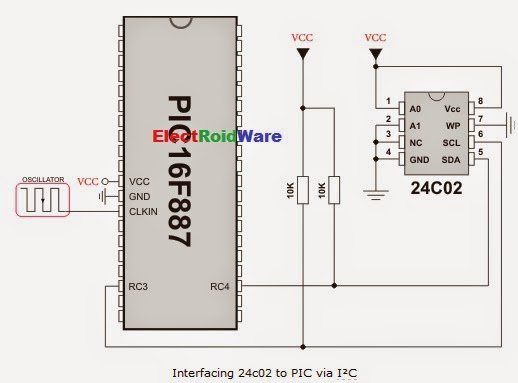
This code demonstrates use of I²C library. PIC MCU is connected (SCL, SDA pins) to 24c02 EEPROM. Program sends data to EEPROM (data is written at address 2). Then, we read data via I²C from EEPROM and send its value to PORTB, to check if the cycle was successful (see the figure below how to interface 24c02 to PIC).
For more detail: Connect I²C with PIC
- How do I initialize the I²C module?
Call the I2C1_Init function with the desired clock value before using other functions. - Can I use multiple I²C modules on one MCU?
Yes, simply change the number in the routine prototype from 1 to the appropriate module number. - Does the I2C1_Start function return an error code?
It returns 0 if there is no error when determining if the bus is free and issuing the START signal. - What happens if the ack parameter is 0 in I2C1_Rd?
The function sends a not acknowledge signal after reading one byte from the slave. - Is manual port configuration required for this library?
No, the library takes care of the initialization so you do not need to configure ports manually. - Why must the clock parameter be a constant?
The compiler calculates the I²C clock value at compile time to avoid producing large code. - When should I use I2C1_Repeated_Start?
Use it to issue a repeated START signal after configuring the I²C module. - How can I check if the I²C bus is free?
Call the I2C1_Is_Idle function which returns 1 if the bus is free and 0 otherwise. - What is required before sending data with I2C1_Wr?
You must configure the I²C and issue a START signal before using this function. - What does the provided code example demonstrate?
It shows writing data to address 2 of a 24c02 EEPROM and reading it back to PORTB.