
Summary of ANALOG LIGHT SENSOR + LIGHT SENSITIVE SWITCH USING OPT101
This article describes a highly sensitive light-sensitive switch circuit utilizing the OPT101 sensor chip instead of a traditional LDR. The board functions as both an analog light sensor and a switch, powered by 12V DC. It uses an LM358 op-amp as a comparator and a BC847 transistor to drive a 10A SPDT relay. Sensitivity is adjustable via a trimmer pot, with LED indicators for power and relay status.
Parts used in the Analog Light Sensor + Light Sensitive Switch:
- OPT101 light sensor chip
- LM358 op-amp
- BC847 transistor
- Relay (SPDT)
- Diode D1
- Diode D2 (Power LED)
- Diode D3 (Relay Status LED)
- PR1 Trimmer Potentiometer
- Header connector CN3
You may have seen many light-sensitive switch circuits based on an LDR sensor. Usually, the sensitivity of the LDR based light sensor is poor. We wanted a very sensitive light switch hence we decided to make a circuit based on a light sensor rather than LDR. After a little research on the internet, we found the OPT101 light sensor chip which includes a photodiode and a transimpedance amplifier in one package. The OPT101 light sensor provides an analog voltage output linearly proportional to light intensity.
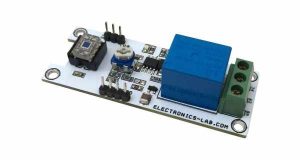
This board has a dual function, it can act as a Light Sensor and a Light Sensitive switch. The operating supply of the circuit is 12V DC and draws 45mA current when Relay is ON. When light falls on the OPT101 sensor and the intensity of light reaches above the set point it triggers the relay. A separate header connector is provided to output the sensor analog value. The output of the sensor is almost 0 (Zero) when it’s in a dark area and goes high till 11.25V when it has access to full light. The sensitivity of the switch is adjustable using the onboard trimmer pot. LM358 op-amp acts as a comparator, BC847 transistor helps to drive the relay, diode D1 protects the transistor from back-EMF of inductive load (Relay). D2 is the power LED and D3 LED indicates the relay ON/OFF function. Relay has SPDT switch with NO (normally open)/NC (Normally Closed) contacts. The contact rating of the relay is 10A and the switching voltage 277V AC, 28V DC Max.
Features
- Operating Power Supply 12V DC
- Current Consumption 45mA (When Relay is in ON)
- SPDT Relay
- Contact Rating of Relay 10Amps and Switching Voltage 28V DC or 277V AC Max
- CN3 Sensor Direct Output (0 to 11.25V + 12V DC Supply + GND)
- D3 LED Relay Operations
- D1 Power LED
- PR1 Sensitivity Adjust
- PCB Dimensions 69.85 x 26.67 mm
Read more: ANALOG LIGHT SENSOR + LIGHT SENSITIVE SWITCH USING OPT101
- What is the main advantage of this circuit over standard LDR based switches?
This circuit provides very high sensitivity because it uses the OPT101 light sensor chip instead of a poor sensitivity LDR. - How does the circuit operate when light intensity changes?
When light falls on the OPT101 and reaches a set point, it triggers the relay; the output voltage goes from zero in darkness to 11.25V in full light. - Can the sensitivity of the switch be adjusted?
Yes, the sensitivity is adjustable using the onboard trimmer pot labeled PR1. - What components are used to drive and protect the relay?
A BC847 transistor drives the relay, while diode D1 protects the transistor from back-EMF generated by the inductive load. - What are the electrical ratings of the relay included in the project?
The relay has a contact rating of 10Amps with a switching voltage of 277V AC or 28V DC Max. - What is the power supply requirement for this board?
The operating supply is 12V DC, drawing 45mA current when the relay is ON. - Does the board provide an analog output signal?
Yes, a separate header connector CN3 allows outputting the sensor analog value ranging from 0 to 11.25V.