
Summary of AMBARELLA CV5 AI VISION SOC FOR LOW POWER COMPUTER VISION APPLICATIONS
Ambarella announced the CV5 AI Vision SoC: a 5nm, low-power processor combining 8K/4K video encoding/decoding with CVflow DNN-based computer vision to enable intelligent automotive, consumer (drone, action, 360°), robotic, and VR cameras, plus multi-channel drive recorders and ADAS applications such as lane departure warning, forward collision warning, and driver monitoring. It runs under 2W for 8K30 and under 5W for 8K60, supports H.265/H.264, multi-streaming, HDR/EIS, LED flicker mitigation, multiple sensor types, and a CNN toolkit compatible with Caffe, TensorFlow, PyTorch, and ONNX.
Parts used in the CV5 AI Vision SoC Project:
- Ambarella CV5 AI Vision SoC (5nm)
- Image sensors (RGGB, RCCB, RCCC, RGB-IR, monochrome)
- Video encoder/decoder supporting H.265 and H.264
- CVflow computer vision engine (DNN/CNN processing)
- CNN toolkit compatible with Caffe, TensorFlow, PyTorch, ONNX
- Multi-exposure HDR image processing module
- Electronic Image Stabilization (EIS) module
- LED flicker mitigation and 3D motion-compensated temporal filtering (MCTF)
- Multi-channel drive recorder/data logger interfaces
Ambarella announced the CV5 AI Vision SoC for AI applications using its specialized computer vision technology. The AI Vision SoC features 8K video or 4K video processing along with video encoding/decoding, and CVflow computer vision processing in a single, low-power design. The SoC is fabricated using 5nm technology and allows the development of intelligent automotive camera systems, consumer cameras (drone, action, and 360°), and robotic cameras.
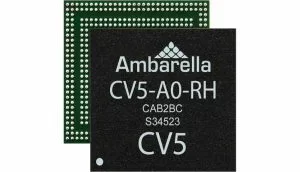
Talking about its low power design, the SoC can function below 2W for 8K video recording at 30 fps, and below 5W for 8K video recording at 60 fps. The CVflow architecture of the device offers the DNN (Deep Neural Network) processing hence, compatible for intelligent cameras in numerous AI applications.
The target applications of the SoC include sports and robotics cameras. It also offers advanced image processing for VR cameras. It supports multi-channel drive recorders and data loggers. The SoC is expected to grow in the automobile industry for ADAS systems with multiple cameras for driver assistance. This includes lane departure warning, forward collision warning, and driver monitoring.
Key Features Of CV5 AI Vision Processor
- High-Efficiency Video Encoding with H.265 and H.264 video compression
- Flexible multi-streaming capability and 8KP60 video performance
- Multiple CBR and VBR bit rate control modes for encoding
- CNN / DNN-based processing for detection and classification
- Computer Vision engine for conventional CV operations
- CNN toolkit for easy porting of neural networks implemented in Caffe, TensorFlow, PyTorch, or ONNX frameworks
- Advanced image processing includes multi-exposure HDR and EIS
- LED flicker mitigation and 3D motion-compensated temporal filtering (MCTF)
- RGGB / RCCB / RCCC / RGB-IR / monochrome sensor support
Read more: AMBARELLA CV5 AI VISION SOC FOR LOW POWER COMPUTER VISION APPLICATIONS
- What fabrication process is used for the CV5 AI Vision SoC?
The CV5 is fabricated using 5nm technology. - Can the CV5 handle 8K video recording and at what power?
Yes; it can record 8K at 30 fps below 2W and 8K at 60 fps below 5W. - Does the CV5 support deep neural network processing?
Yes; its CVflow architecture offers CNN/DNN-based processing for detection and classification. - What video codecs does the CV5 support?
It supports H.265 and H.264 video compression. - Is there toolkit support for porting neural networks?
Yes; a CNN toolkit supports porting networks from Caffe, TensorFlow, PyTorch, and ONNX. - What sensor types does the CV5 support?
It supports RGGB, RCCB, RCCC, RGB-IR, and monochrome sensors. - Can the CV5 be used for automotive ADAS applications?
Yes; it targets automotive ADAS with multiple cameras for functions like lane departure warning, forward collision warning, and driver monitoring. - Does the CV5 include advanced image processing features?
Yes; it includes multi-exposure HDR, EIS, LED flicker mitigation, and 3D motion-compensated temporal filtering.