
Summary of ACTIVE RECTIFIER CONTROLLER WITH REVERSE PROTECTION FOR BATTERY AND SOLAR CELL
This demo circuit is a 5A active rectifier with reverse-input protection using the LT8672 controller. It drives an external N-channel MOSFET as an ideal diode, regulating SOURCE–DRAIN forward drop to 20 mV, using fast pull-up/pull-down paths for rapid transients. Auxiliary boost provides gate drive (AUX = DRAIN + 11 V). SOURCE and GATE are protected to –40 V. Two clamping diodes and input/output LEDs and connectors complete the board for 12–24 V automotive/battery or solar applications.
Parts used in the Active Rectifier with Reverse Protection for Battery and Solar Cell:
- LT8672 active rectifier controller IC
- N-channel MOSFET (Q1)
- Clamping diode D1
- Clamping diode D2
- Input power LED (D2)
- Output power LED (D4)
- Auxiliary boost regulator (provides AUX = DRAIN + 11V)
- Connectors CN1 (input)
- Connector CN2 (output)
- Gate amplifier circuitry/internal to LT8672 (for GATE sensing and control)
This demonstration circuit is an active rectifier with reverse protection for batteries in automotive applications. The project is designed for 5A load current. Two clamping diodes, D1 and D2, are used on the board to protect the IC from overvoltage spikes at the input. The input supply range is 12V to 24V. The active rectifier controller chip LT8672 controls an external N-channel MOSFET (Q1) to form an ideal diode. The GATE amplifier senses across DRAIN and SOURCE and drives the gate of the MOSFET to regulate the forward voltage to 20mV. As the load current increases, GATE is driven higher until a point is reached where the MOSFET is fully on. If the load current is reduced, the GATE amplifier drives the MOSFET gate lower to maintain a 20mV drop. If the voltage VDRAIN is reduced to a point where a forward drop of 20mV cannot be supported, the GATE amplifier drives the MOSFET off.
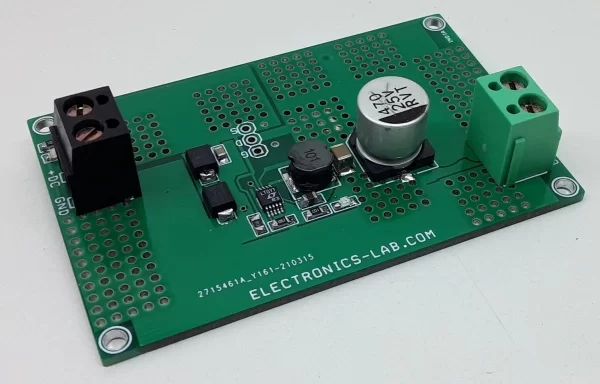
During fast SOURCE–DRAIN transients such as fast varying input (SOURCE) signals where the regulating 20mV loop is too slow, fast pull-up (FPU) and fast pull-down (FPD) current paths turn on and off the external MOSFET quickly. This rectifies the input signal the same way a diode would do but with much less power dissipation. The SOURCE and GATE pins are protected against reverse input voltages of up to –40V. GATE is pulled to SOURCE when SOURCE goes negative, turning off the MOSFET and isolating DRAIN from the negative input. The gate voltage for the external MOSFET is provided by the auxiliary boost regulator, which regulates its output AUX to 11V above DRAIN. D2 Input power LED, D4 output power LED, CN1 input , CN2 output.
WHAT IS ACTIVE RECTIFICATION?
Active rectification is a technique for improving the efficiency of rectification by replacing diodes with actively controlled switches like MOSFET-based circuits, whereas normal semiconductor diodes have a roughly fixed voltage drop of around 0.5-1 volts, active rectifiers behave as resistances, and can have an arbitrarily low voltage drop. Active rectification has many applications. It is frequently used for arrays of photovoltaic panels to avoid reverse current flow that can cause overheating with partial shading while giving minimum power loss. The constant voltage drop of a standard p-n junction diode is typically between 0.7 V and 1.7 V, causing significant power loss in the diode. Electric power depends on current and voltage: the power loss rises proportionally to both current and voltage.
Read more: ACTIVE RECTIFIER CONTROLLER WITH REVERSE PROTECTION FOR BATTERY AND SOLAR CELL
- What load current is this active rectifier designed for?
It is designed for 5A load current. - What input supply range does the circuit support?
The input supply range is 12V to 24V. - Which controller IC is used to drive the external MOSFET?
The LT8672 active rectifier controller is used. - How does the circuit regulate the forward voltage drop?
The GATE amplifier senses across DRAIN and SOURCE and drives the MOSFET gate to regulate the forward voltage to 20mV. - How does the circuit behave during fast SOURCE–DRAIN transients?
Fast pull-up and fast pull-down current paths quickly turn the MOSFET on and off to rectify transients similarly to a diode but with lower dissipation. - What protection is provided for reverse input voltages?
SOURCE and GATE pins are protected against reverse input voltages up to –40V, and GATE is pulled to SOURCE when SOURCE goes negative to turn off the MOSFET. - What provides the MOSFET gate voltage and what is its level?
The auxiliary boost regulator provides the gate voltage, regulating AUX to 11V above DRAIN. - What components protect the IC from input overvoltage spikes?
Two clamping diodes, D1 and D2, are used to protect the IC from overvoltage spikes at the input.