
Summary of Wrist Mount Digital Altimeter
This project describes a wrist-mounted digital altimeter that calculates altitude using atmospheric pressure. The system employs an MS560702BA03-50 barometric sensor to capture pressure and temperature data, which is processed by a microcontroller via SPI. The calculated altitude is displayed on an 84x84 pixel graphic LCD, typically sourced from old phones, and the circuit operates on a 3.3V battery. Designed for navigation in activities like skydiving and hiking, this device offers high resolution for outdoor use.
Parts used in the Wrist Mount Digital Altimeter:
- Microcontroller (MCU)
- MS560702BA03-50 barometric pressure sensor
- 84x84 pixel graphic LCD
- 3.3V battery
This project is a simple wrist mount digital altimeter which is a device used to determine altitude. This design uses atmospheric pressure to calculate the altitude of its location. The lower the atmospheric pressure, the higher the altitude. The project is comprised of a microcontroller (MCU), an 84×84 pixel graphic LCD and a barometric pressure sensor.
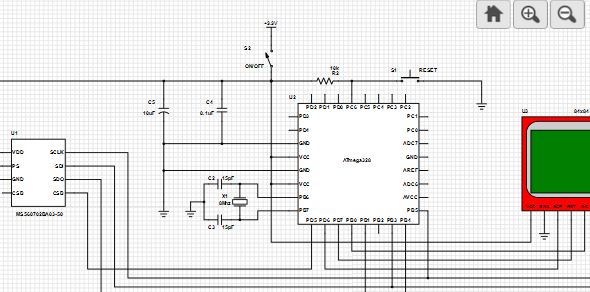
The barometric pressure sensor used in the design is the MS560702BA03-50 from TE Connectivity Measurement Specialties. It consists of a piezo-resistive sensor and a sensor interface IC. Its main function is to convert the uncompensated analogue output voltage from the piezo-resistive pressure sensor to a 24-bit digital value, as well as providing a 24-bit digital value for the temperature of the sensor. It is optimized for altimeters and variometers with an altitude resolution of 20cm. The MS560702BA03-50 measures the atmospheric pressure on its location then converts it to a 24-bit value through its internal ADC. The sensor reading is then transmitted to the MCU through SPI. Then the MCU calculates the altitude by using the pressure reading. The calibration of an altimeter follows the equation z = cT log (Po /P), where c is a constant, T is the absolute temperature, P is the pressure at altitude z, and Po is the pressure at sea level. The calculated altitude is then displayed through an 84×84 pixel graphic LCD which is mostly found on old phones. The circuit is powered through a 3.3V battery.
The altimeter is used to aid navigation and is mostly used in skydiving, mountaineering and hiking applications. It is usually hand-held or in wrist-mount form for the ease of use. Altimeters can also be found in aircrafts such as planes and helicopters and others that needs altitude indication.
For more detail: Wrist Mount Digital Altimeter
- How does the device determine altitude?
The design uses atmospheric pressure to calculate altitude based on the principle that lower pressure indicates higher altitude. - What specific sensor model is used in the project?
The project utilizes the MS560702BA03-50 from TE Connectivity Measurement Specialties. - Does the sensor output analog or digital values?
The sensor converts the analog output voltage into a 24-bit digital value for both pressure and temperature. - How is data transmitted between the sensor and the microcontroller?
The sensor reading is transmitted to the MCU through the SPI interface. - What equation is used for calibration?
The calibration follows the equation z = cT log (Po /P). - Where does the graphic LCD come from?
The 84x84 pixel graphic LCD is mostly found on old phones. - Can this device be used in aircraft?
Yes, altimeters are also found in aircraft such as planes and helicopters that need altitude indication. - What power source supplies the circuit?
The circuit is powered through a 3.3V battery.