
Summary of VACUUM TUBE PRE-AMPLIFIER RUNS ENTIRELY ON 3.3V, INCLUSIVE OF FILAMENT VOLTAGE
Albert van Dalen successfully designed a vacuum tube pre-amplifier operating on 3.3V, including filament voltage, down from standard 60V or 12V supplies. By utilizing a bipolar transistor-like grid bias instead of a single-ended design, the device runs via USB while delivering undistorted audio with a gain of -3.5. Notable operational oddities include positive grid-cathode voltage and high grid current.
Parts used in the Albert van Dalen Vacuum Tube Pre-Amplifier:
- DIY 6J1 tube
- Low power supply (3.3V)
- Bipolar transistor-style grid bias circuit
- USB power source
Most vacuum tubes need about 6.3V high supply plus filament voltage to operate. Running at 3.3V inclusively of the filament voltage, the new vacuum tube amplifier from Albert van Dalen has proven it possible to have one with the capacity to operate on an entirely low power supply voltage and still work well.
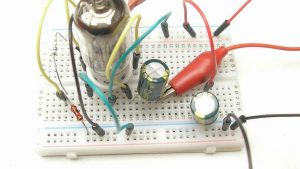
To be able to do experiments with vacuum tubes, I bought a cheap DIY 6J1 tube amplifier on Ali Express. Like most vacuum tube circuits, it uses a relatively high supply voltage of 60V. However, a high voltage is not always required for vacuum tubes, sometimes 12V is used. I was curious how far one can go with reducing the power supply. Nowadays the most common used power supply voltage for electronics is 3.3V and before this was 5V.” says van Dalen as he explains how he started with his design and was able to gradually decrease the voltage going from 60 V to 12 V to 5 V and then finally down to 3.3V partly by using a grid bias that looks like a bipolar transistor instead of the usual single-ended design.
Van Dalen also added that asides being able to work with a low supply voltage, power the preamp can also be used for audio purposes and can easily be powered from a USB.
Tube amplifiers are used for nostalgia reasons and to get the characteristic tube sound. For this purpose, this preamp is useful, and you can simply power it from USB. The gain is -3.5 and music sounds undistorted. Just the red light from the filament is dimmed.
However, some of the oddities caused by this very low supply voltage as observed by van Dalen in his experiment included a positive grid-cathode voltage instead of being negative and a very high grid current of 0.3 mA.
Read more: VACUUM TUBE PRE-AMPLIFIER RUNS ENTIRELY ON 3.3V, INCLUSIVE OF FILAMENT VOLTAGE
- Can this vacuum tube amplifier operate on 3.3V?
Yes, the new amplifier can run entirely on 3.3V inclusive of filament voltage. - How did the designer reduce the supply voltage?
Voltage was reduced by using a grid bias resembling a bipolar transistor instead of a single-ended design. - Does the preamp work well for audio purposes?
Yes, it produces undistorted music sound with a gain of -3.5. - What is the typical supply voltage for most vacuum tubes?
Most vacuum tubes require about 6.3V high supply plus filament voltage to operate. - Is it possible to power this preamp from a USB?
Yes, the preamp can easily be powered from a USB connection. - What oddities were observed at very low supply voltages?
Experiments showed a positive grid-cathode voltage and a very high grid current of 0.3 mA. - Why are tube amplifiers often used?
They are used for nostalgia reasons and to achieve the characteristic tube sound. - What happens to the red light from the filament?
The red light from the filament becomes dimmed during operation.
