


Summary of USB PIC Programmer : PICKit2 using pic microcontoller
This article details a modified version of Microchip's PICKit2, a USB-based ICSP programmer. The modification simplifies the original hardware by removing the EEPROMs and replacing bipolar transistors with MOSFETs to reduce component count. It also adds an ICSP-to-ZIF converter for versatility and substitutes the mini-USB connector with a standard USB-B type. While originally supporting 5V devices, this modified circuit requires an additional step for 3.3V compatibility.Parts used in the Modified PICKit2:
- Microcontroller PIC18F2550
- External crystal oscillator X1
- Capacitors C2 and C3
- Inductor L1
- MOSFET Q1
- Diode D1
- Capacitors C1 and C4
- Standard USB-B connector
- ICSP to ZIF converter
Microchip’s PICKit2 is much more comfortable,reliable and powerful than the other programmers that we can find all over internet. It is a USB based ICSP (In Circuit Serial Programming) programmer. Since it is a first release, Microchip published all the resources of PICKit2 public, which includes hardware schematics and all source code of softwares used. Through this any one can add features, fix bugs and modify source code.
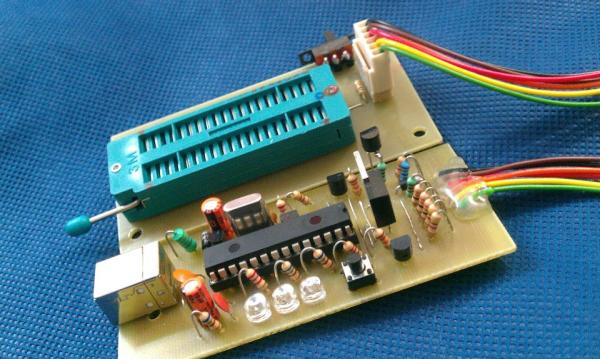 Documents and other supporting files of PICKit2 are available at Microchip’s Website.
We have simplified the hardware schematics of PICKit2 by removing all unnecessary devices from it and ICSP to ZIF converter is also added for easier programming. The main differences between the modified PICKit2 and Original PICKit2 are:
1. ICSP to ZIF converter is added for easier programming, thus we can use ICSP or ZIF socket according to our needs.
2. It supports only 5V PIC’s, thus 3.3V devices a small additional circuit to convert 5V to 3.3V.
3. Two 24C512 EEPROM’s used only for programmer-to-go function in the Original PICKit2 were omitted. The Programmer-to-go function is not an important feature for a electronics hobbyist.
4. Bipolar transistors used in Original PICKit2 are replaced by MOSFETs, thus minimal additional components are required.
5. The mini USB connector is replaced by commonly available USB-B connector.
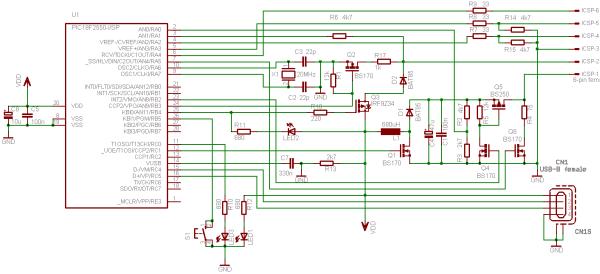
USB PIC Programmer PICKit2 Modified Circuit Diagram
PICKit2 is a USB powered device, that is it gets power from PC USB +5V power supply. USB microcontroller PIC18F2550 is the soul of the PICKit2. The USB Data+ and Data- from PC are connected to the D+ and D- pins of the PIC182550. The built-in-clock generator of pic uses external crystal oscillator X1, C2 and C3 to ensure the correct system clock rate. The inductor L1, MOSFET Q1, diode D1, capacitors C1 and C4 forms a DC-DC converter (Buck Converter) which converts 5V from PC to 12V, which to be applied to MCLR/VPP pin of a microcontroller at the time of programming.
For more detail: USB PIC Programmer PICKit2
Quick Solutions to Questions related to Modified PICKit2:
- How does the modified PICKit2 handle 3.3V devices?
The project supports only 5V PICs, requiring a small additional circuit to convert 5V to 3.3V. - What is the main difference between the original and modified PICKit2 regarding
connectors?
The mini USB connector is replaced by a commonly available USB-B connector. - Can I modify the source code for the PICKit2?
Yes, Microchip published all resources including hardware schematics and software source code for public modification. - Which transistors are used in the modified circuit?
Bipolar transistors from the original design are replaced by MOSFETs to require minimal additional components. - Does the modified version include the Programmer-to-go function?
No, the two 24C512 EEPROMs used for this feature were omitted as it is not important for hobbyists. - How is the programming voltage generated in this circuit?
An inductor, MOSFET, diode, and capacitors form a DC-DC Buck Converter that converts 5V to 12V for the MCLR/VPP pin. - What power source does the PICKit2 use?
The device is USB powered and gets its power from the PC USB +5V supply.
Related projects
CAN FD Node based on a PIC18 Microcontroller
The introduction sets the stage for an embedded systems project that involves developing a Embedded C CAN FD project using the MCP2517FD...
Communication & InterfacingLAN9662 Gigabit Switch: Optimized for Industrial Ethernet
Introduction It should come as little surprise therefore that one element of what is now more commonly referred to in some circles...
Communication & InterfacingPIC Microcontroller: Fundamentals & Applications for Students
Introduction Microcontrollers are the key components in the embedded systems market. A variety of embedded systems was formed and developed after the...
Communication & Interfacing10BASE-T1S Ethernet: Simplified OEM Design for Auto Devices
Introduction Cars these days are surrounded by technology. They come loaded with all sorts of electronic gadgets and sensors. This project wants...
Communication & InterfacingDesigning a Microcontroller Framework for PC-Based Control of Electrical Appliances
ABSTRACT The preference for personal computers as a platform for designing and implementing control algorithms is growing due to the ease of...
Communication & InterfacingEfficient Multichannel Data Acquisition with USB Connectivity using PIC Microcontroller
1. INTRODUCTION With the rapid advancements in embedded technology, there is a growing demand for a data acquisition system that combines fast...

Ibrar Ayyub
I am an experienced technical writer holding a Master's degree in computer science from BZU Multan, Pakistan University. With a background spanning various industries, particularly in home automation and engineering, I have honed my skills in crafting clear and concise content. Proficient in leveraging infographics and diagrams, I strive to simplify complex concepts for readers. My strength lies in thorough...