
Summary of TYRE PRESSURE MONITORING SYSTEM USING BLUETOOTH LOW ENERGY
This article discusses a Bluetooth Low Energy (BLE) based Tyre Pressure Monitoring System (TPMS) designed to enhance road safety and reduce tyre wear. It highlights the DA14585 System on Chip (SoC) as the core component, leveraging its ARM M0 core, extensive RAM, and low power consumption for real-time data transmission. The system supports both direct and indirect TPMS types, offering long battery life suitable for M2M communication in automotive and IoT applications.
Parts used in the Tyre Pressure Monitoring System:
- Tyre pressure monitoring system (TPMS)
- Sub-GHz radio standards
- Bluetooth low energy (BLE) connectivity
- DA14585 SoC
- ARM M0 core
- Integrated microphone interface
- User interface
- Small battery
A tyre pressure monitoring system (TPMS) aims to monitor air pressure on various automotive systems. The most common TPMS sensors mainly use sub-GHz radio standards to transfer information to the vehicle’s computer. There are two different types: direct (dTPMS) and indirect (iTPMS). The use of bluetooth low energy (BLE) connectivity makes it possible offering a high performance. All information will be displayed in real-time by simple user interface with low power consumption. With low power consumption, applications can run on a small battery for many years. As result, it’s actually extremely positive when talking about M2M communication and automotive systems.
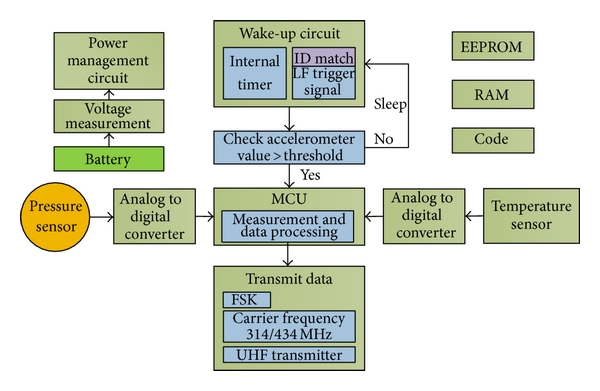
TPMS helps to avoid the tyre wear and improves road safety. Due to the advantages of a longer battery life and connectivity, DA14585 is suitable for IoT applications in various industries. The figure 1 show a typical block diagram for a TPMS system.
Bluetooth low energy for automotive industry
Connectivity, Intelligence and energy saving are the main features for the new generation of IoT devices. Luckily, SmartBond can achieve all these features. Especially relevant is one of the series, DA14585 SoC. It offers all benefits, such as, full support of all bluetooth standards, including version 5. Moreover, it is suitable for many applications, as remote controls, proximity tags, headlights, connected medical devices, smart home and smart automotive (Figure 2). The figure 2 shown the block diagram of DA14585, where is visualized the ARM M0 core and other peripherals.
With 96 kB of RAM and retention capability, DA14585 offers a wider memory than its predecessor in order to fully utilize standard features. Moreover, it also includes an integrated microphone interface for low-cost voice support. DA1485 supports a wide range of power supply voltages from 0.9 to 3.6 V. This range offers a wider choice of energy sources with a great design performance.
Read More: TYRE PRESSURE MONITORING SYSTEM USING BLUETOOTH LOW ENERGY
- How does a TPMS improve road safety?
It helps to avoid tyre wear and improves road safety by monitoring air pressure. - What type of radio standards do most common TPMS sensors use?
The most common TPMS sensors mainly use sub-GHz radio standards to transfer information. - Can the system run on a small battery for many years?
Yes, due to low power consumption, applications can run on a small battery for many years. - Does the DA14585 support Bluetooth version 5?
Yes, it offers full support of all bluetooth standards, including version 5. - What is the memory capacity of the DA14585 SoC?
It has 96 kB of RAM with retention capability. - Can the DA14585 be used for voice support?
Yes, it includes an integrated microphone interface for low-cost voice support. - What voltage range does the DA14585 support?
It supports a wide range of power supply voltages from 0.9 to 3.6 V. - Are there different types of TPMS mentioned in the text?
Yes, there are two different types: direct (dTPMS) and indirect (iTPMS).