
Summary of Triac based lamp dimmer
This project is a low-cost triac-based dimmer for adjusting brightness of incandescent and halogen lamps up to 250 W, compatible with 110 VAC or 230 VAC supplies. It features an onboard potentiometer, power battery terminals for easy connections, four 3.2 mm mounting holes, and a PCB sized 40 mm x 34 mm.
Parts used in the Triac based lamp dimmer:
- BT136 Triac
- Resistors
- Capacitor
- On-board potentiometer
- Power Battery Terminal (PBT)
- CN1 connector (Load connections)
- CN2 connector (Power supply connections)
- PCB (40 mm x 34 mm) with four 3.2 mm mounting holes
Description
It is a low cost dimmer circuit for adjusting the light brightness of incandescent, Halogen Lamp, Light Bulb load up to 250 W.
Features:
– Input supply: 230 VAC or 110 VAC
– Output: 250 W
– Triac controlled
– On board Potentiometer for adjusting level
– Power Battery Terminal (PBT) for easy input / output connection
– Four mounting holes of 3.2 mm each
– PCB dimensions 40 mm x 34 mm
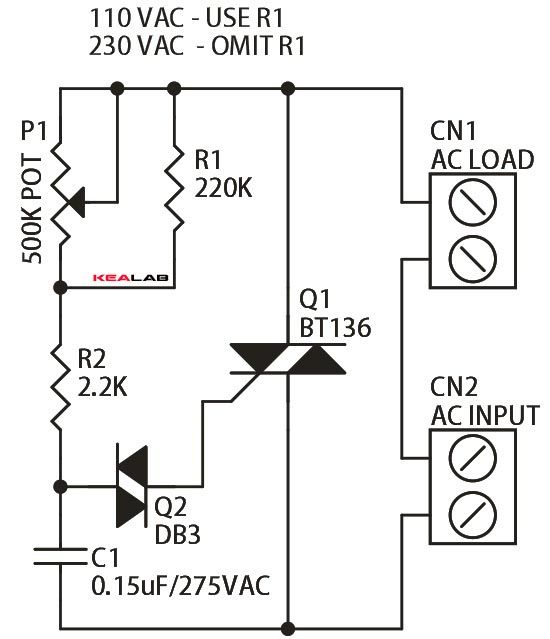
Circuit description
This kit consists of BT 136 Triac, resistors and capacitor. CN1 connector is for Load connections and CN2 connector for power supply connections.
For more detail: Triac based lamp dimmer
- What is the maximum load this dimmer supports?
The dimmer supports loads up to 250 W. - What input supply voltages does the dimmer accept?
The dimmer accepts 230 VAC or 110 VAC input supply. - Which triac is used in this dimmer circuit?
The kit uses a BT136 Triac. - How is brightness adjusted on this dimmer?
Brightness is adjusted using the on-board potentiometer. - What connectors are provided for connections?
CN1 is for load connections and CN2 is for power supply connections; a Power Battery Terminal (PBT) is also provided for easy input/output connection. - What are the PCB dimensions and mounting provisions?
The PCB measures 40 mm x 34 mm and has four mounting holes of 3.2 mm each.
