
Summary of TOSHIBA ANNOUNCES NEW PHOTOVOLTAIC-OUTPUT PHOTOCOUPLER
Toshiba released the TLP3910 photovoltaic-output photocoupler in a thin SO6L package (3.84 × 10 × 2.1 mm) for driving high-voltage power MOSFET gates in galvanically-isolated solid-state relays. Unlike earlier devices needing two units in series, the TLP3910 delivers a minimum open-circuit voltage of 14V, allowing a single component to drive MOSFET gates (≈10V), reducing part count, PCB space, BOM cost, and improving reliability for SSR applications in industrial and instrumentation equipment.
Parts used in the TLP3910 Photovoltaic Coupler Project:
- Toshiba TLP3910 photovoltaic-output photocoupler (SO6L package)
- High-voltage power MOSFET
- Printed circuit board (PCB)
- Optical input source (LED/drive circuit for the coupler)
- Supply and gate drive passive components (resistors, capacitors)
- Connectors and isolation creepage/clearance hardware for SSR
Toshiba Electronics Europe GmbH (“Toshiba”) has launched a new photovoltaic-output photocoupler (“photovoltaic coupler”) housed in a thin SO6L package measuring just 3.84mm × 10mm × 2.1mm, suitable for driving the gates of high-voltage power MOSFETs used to develop a galvanically-isolated solid-state relay (SSR) function.
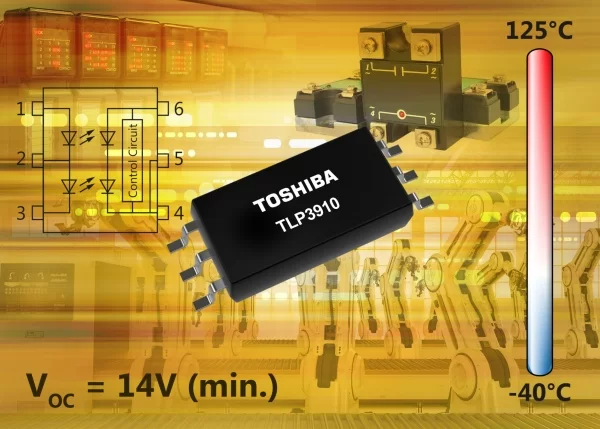
SSRs are semiconductor relay devices that incorporate a photo-TRIAC, a photo-transistor or a photo-thyristor as the output device. They are generally suitable for applications that require ON/OFF control of large electrical currents such as industrial equipment (I/O relay output for PLCs, inrush current protection in PSUs, battery voltage monitoring in BMS, ground fault detection and more) as well as switching the power and signal lines in instrumentation applications.
A photovoltaic coupler, such as the new TLP3910, is a photorelay that contains the optical elements but not the MOSFET that performs the high-current switching functions. To easily configure an isolated SSR to handle high-voltage, large-current switching (which photorelays find challenging), designers generally combine a photovoltaic coupler with a MOSFET.
Driving a high-voltage power MOSFET with a gate voltage of 10V or higher, currently requires connecting two of Toshiba’s TLP3906 in series, due to the low open voltage that is around 7V. However, the new TLP3910 has a minimum open voltage (VOC) of 14V, double that of the TLP3906 and, as a result, only a single device is required to drive the gate of a high-voltage power MOSFET. This reduces the part count, thereby improving reliability and saving PCB space and BOM cost.
Read more: TOSHIBA ANNOUNCES NEW PHOTOVOLTAIC-OUTPUT PHOTOCOUPLER
- What package does the TLP3910 use?
The TLP3910 is housed in a thin SO6L package measuring 3.84mm × 10mm × 2.1mm. - Can the TLP3910 drive a high-voltage MOSFET gate by itself?
Yes, the TLP3910 has a minimum open voltage of 14V, enabling it to drive a MOSFET gate (around 10V) by itself. - How does the TLP3910 compare to the TLP3906 for gate drive voltage?
The TLP3910 has a minimum open voltage of 14V, double the TLP3906's approximately 7V open voltage, so only one TLP3910 is needed instead of two TLP3906 devices in series. - What application types are SSRs suitable for?
SSRs are suitable for ON/OFF control of large currents in industrial equipment, power supplies, battery monitoring in BMS, ground fault detection, and instrumentation switching. - Does a photovoltaic coupler include the switching MOSFET?
No, a photovoltaic coupler like the TLP3910 contains the optical elements but not the MOSFET; designers pair it with a MOSFET to handle high-current switching. - What are the benefits of using a single TLP3910 in SSR designs?
Using a single TLP3910 reduces part count, improves reliability, saves PCB space, and lowers BOM cost. - Why do designers combine a photovoltaic coupler with a MOSFET?
Designers combine them because photorelays alone find high-voltage, large-current switching challenging, so the coupler provides isolated gate drive while the MOSFET handles the high-current switching.