
Summary of They act only ones – right then, when it´s really necessary
This article explains the critical role of thermal fuses in preventing device failures, fires, and further damage caused by overheating. It highlights these components as cheap, one-time protection devices that disconnect circuits when temperatures exceed a specific threshold. The text details how Microtemp fuses from Thermodisc operate by melting a plastic pellet to release a spring, offering a wide temperature range (72-257°C) for various applications like guarding air temperature or protecting transistor heatsinks.
Parts used in the Thermal Fuse Protection Project:
- Thermal fuse
- Plastic pellet
- Spring
- Circuit contacts
- Microtemp fuses
- Thermodisc company products
- Transistor heatsink
It´s surely not necessary to remind that any device can fail. Failure of a component, overload of a component (underestimated sizing), external influence and many other reasons are daily causing failures of devices. If the result of a malfunction is only an intermediate shutdown, it´s let´s say a better case. But if a device malfunction could cause further damage or even fire, it´s surely worth to make everything possible to prevent it.
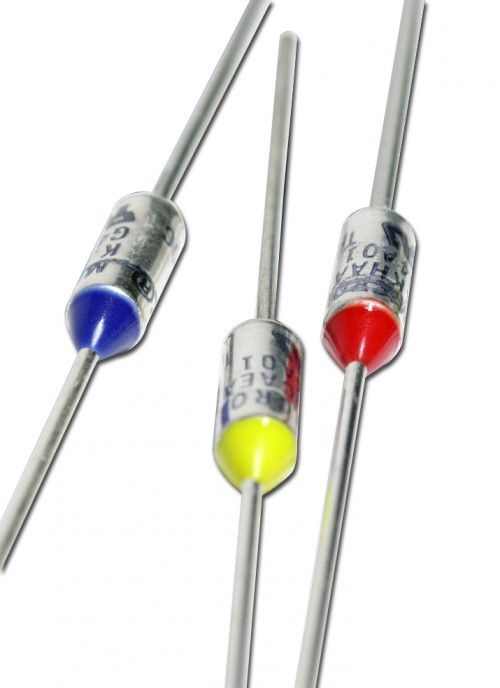
A typical component used as a complementary – independent protection from overheating is a thermal fuse. It is a cheap but very useful component, which opens (disconnects) a circuit after exceeding certain temperature. It is a “one shot” component, i.e. after its activation it remains open and the fused circuit is disconnected (the fuse must be exchanged). It´s suitable to choose such fusing temperature of the fuse, as we consider to be really faulty, which otherwise can´t occur in an ordinary operation. Production processes enable to produce thermal fuses in a wide range of temperatures and so fuses Microtemp from company Thermodisc, which we keep in stock, are available in a range of 72-257°C (opening temperature). It´s a really wide range enabling to use a fuse for example for fusing of other component (for example a thermal fuse thermally joined with a transistor heatsink) but also for guarding an air temperature inside a device. These fuses operate on a principle of melting a small plastic pellet inside a fuse, what will cause release of a spring and a consequent disconnection of contacts.
For More Detail: They act only ones – right then, when it´s really necessary
- What is the primary function of a thermal fuse?
A thermal fuse opens or disconnects a circuit after exceeding a certain temperature to prevent damage or fire. - Can a thermal fuse be reused after activation?
No, it is a one-shot component that remains open and must be exchanged after activation. - What is the operating principle of Microtemp thermal fuses?
They operate by melting a small plastic pellet inside the fuse, which releases a spring to disconnect the contacts. - What temperature range is available for Microtemp fuses?
Microtemp fuses are available with opening temperatures ranging from 72 to 257 degrees Celsius. - How can a thermal fuse be used to protect a transistor?
A thermal fuse can be thermally joined with a transistor heatsink to provide fusing protection for the component. - What happens if a device malfunction causes further damage?
It is worth making everything possible to prevent such scenarios using independent protection like thermal fuses. - Why is selecting the correct fusing temperature important?
You should choose a fusing temperature that you consider faulty but would not occur during ordinary operation. - Are thermal fuses considered expensive components?
No, they are described as cheap but very useful components for complementary independent protection.