
Summary of THE MOST EFFICIENT HEAT SINKS ARE PRODUCED COST-EFFICIENTLY BY VALCUN
The article discusses ValCUN's hybrid manufacturing approach to produce high-performance, cost-efficient heat sinks for applications like IGBT cooling. By combining traditional methods (die-casting, extrusion) with metal additive manufacturing (AM), the company overcomes the limitations of pure AM regarding speed and cost while enabling complex generative designs that significantly improve thermal transfer.
Parts used in the Heat Sink Project:
- IGBTs
- Fluids (water, glycol)
- Heat sinks
- Aluminium profile (traditional air cooling reference)
- Diecasting components
- Additive manufactured components
We live in a society in which we strive for higher performance and efficiency in everything around us. Computers go to a 7nm process, supercomputers do 148.6 petaflops and electric cars aim for a range of 1000km. From a technological point of view, these evolutions usually come down to a higher energy density, and related temperature hotspots. Traditional solutions such as air cooling with extruded aluminium profile are no longer sufficient.
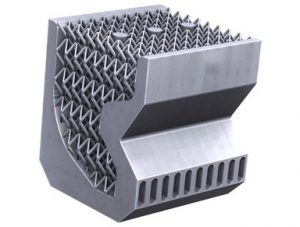
There is a need for more efficient cooling to maintain our technological progress. Cooling with a fluid (water, glycol, …) instead of air provides 10x to 100x better thermal transfer. An optimized design of the heat sink can increase the efficiency by a factor of two or more. Generative optimised design is so complex that they cannot be produced by traditional techniques such as milling, die-casting, extrusion, … The only alternative is an additive manufacturing (AM).
Several metal AM techniques are available today. Main disadvantage of these AM technologies is the production price and speed. These barriers are the main reasons why we don’t yet see them in mainstream applications. Economical serial production of complex heat sinks is the focus of ValCUN. This is done by hybrid manufacturing. Hightech where needed and fast and economical where possible. ValCUN combines traditional production technologies such as diecasting or extrusion with its disruptive metal AM technology.
For the cooling of three IGBT’s a generative design increased cooling performance by 40%. Manufacturing 100.000 coolers with metal additive manufacturing technology known as SLM would not be possible within two year on one machine and would cost more than € 100 per part. Combining diecasting with ValCUN’s AM technology makes it possible to produce this batch in 6 months at a unit price of a factor 3 to 5 less.
Read more: THE MOST EFFICIENT HEAT SINKS ARE PRODUCED COST-EFFICIENTLY BY VALCUN
-
Why are traditional air cooling solutions no longer sufficient?
Traditional solutions like air cooling with extruded aluminium profiles cannot handle the higher energy density and temperature hotspots associated with modern technological evolutions. -
How much better is fluid cooling compared to air cooling?
Cooling with a fluid such as water or glycol provides 10x to 100x better thermal transfer than air. -
Why can't generative optimized designs be produced by traditional techniques?
Generative optimized designs are too complex to be produced by traditional techniques such as milling, die-casting, or extrusion. -
What is the main disadvantage of current metal additive manufacturing technologies?
The main disadvantages are the high production price and slow speed, which prevent their use in mainstream applications. -
How does ValCUN combine different manufacturing methods?
ValCUN uses hybrid manufacturing by combining traditional production technologies like diecasting or extrusion with its disruptive metal additive manufacturing technology. -
What performance increase was achieved for three IGBTs using generative design?
A generative design increased cooling performance by 40% for the cooling of three IGBTs. -
Why was producing 100,000 coolers via SLM considered unfeasible?
Producing this batch via SLM would take more than two years on one machine and cost more than €100 per part. -
What are the benefits of combining diecasting with ValCUN's AM technology?
This combination allows the batch to be produced in 6 months at a unit price that is a factor of 3 to 5 less than pure AM production.