Summary of TCA4307 HOT-SWAPPABLE I2C BUS AND SMBUS BUFFER
The TCA4307 is a hot-swappable I2C bus buffer by Texas Instruments designed to prevent data corruption during live card insertion. It features automatic stuck bus recovery, pre-charging capabilities to minimize current spikes, and isolation between backplane and card sides. The device supports bidirectional transfer across a wide voltage range and includes a READY output pin to indicate connection status.
Parts used in the TCA4307 Project:
- TCA4307 Hot-Swappable I2C Bus Buffer
- Backplane-side I2C lines (in)
- Card-side I2C lines (out)
- SDA and SCL lines
- EN-pin for shutdown control
- Open-drain READY output pin
- Power supply voltage source (2.3 V to 5.5 V)
Texas Instruments’ buffer features stuck bus recovery
Texas Instruments’ TCA4307 is a hot-swappable I2C bus buffer that supports I/O card insertion into a live backplane without corruption of the data and clock lines. Control circuitry prevents the backplane-side I2C lines (in) from being connected to the card-side I2C lines (out) until a stop command or bus idle condition occurs on the backplane without bus contention on the card. When the connection is made, this device provides bidirectional buffering, keeping the backplane and card capacitances isolated. During insertion, the SDA and SCL lines are pre-charged to 1 V to minimize the current required to charge the parasitic capacitance of the device.
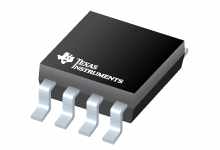
The TCA4307 has stuck bus recovery, which automatically disconnects the bus if it detects either SDAOUT or SCLOUT are low for about 40 ms. Once the bus is disconnected, the device automatically generates up to 16 pulses on SCLOUT to attempt to reset the device which is holding the bus low. When the I2C bus is idle, the TCA4307 can be put into shutdown mode by setting the EN-pin low, reducing power consumption. When EN is pulled high, the TCA4307 resumes normal operation. This buffer includes an open-drain READY output pin, which indicates that the backplane and card sides are connected. When READY is high, the SDAIN and SCLIN are connected to SDAOUT and SCLOUT. When the two sides are disconnected, READY is low.
- Supports bidirectional data transfer of I2C bus signals
- Operating power supply voltage range: 2.3 V to 5.5 V
- Ambient air temperature range (TA): -40°C to +125°C
- Stuck bus recovery featuring automatic bus recovery
- 1 V pre-charge on all SDA and SCL lines prevents corruption during live insertion
- Accommodates standard-mode and fast-mode I2C devices
- Supports clock stretching, arbitration, and synchronization
- Powered-off high-impedance I2C pins
Read more: TCA4307 HOT-SWAPPABLE I2C BUS AND SMBUS BUFFER
-
What is the primary function of the TCA4307?
It is a hot-swappable I2C bus buffer that prevents data corruption during live I/O card insertion. -
How does the device handle stuck bus conditions?
It automatically disconnects the bus if SDAOUT or SCLOUT stay low for about 40 ms and generates up to 16 pulses on SCLOUT to reset the holding device. -
Can the TCA4307 be used with powered-off cards?
Yes, it features powered-off high-impedance I2C pins to accommodate such scenarios. -
What voltage range does the operating power supply support?
The device operates within a power supply voltage range of 2.3 V to 5.5 V. -
How does the device minimize current during insertion?
It pre-charges the SDA and SCL lines to 1 V to reduce the current needed to charge parasitic capacitance. -
What does the READY output pin indicate?
A high READY signal indicates that the backplane and card sides are connected, while low indicates they are disconnected. -
How can power consumption be reduced when the bus is idle?
Setting the EN-pin low puts the TCA4307 into shutdown mode.