
Summary of Self-tinting “breathing” window doubles as a transparent battery
Scientists at NTU developed a self-powered smart window that tints blue to block light and functions as a transparent battery charging via ambient oxygen. This bi-functional device eliminates external power needs, addressing building cooling costs. The prototype uses two glass panes with electrical cables, an oxygen-carrying liquid electrolyte, transparent conductive coating, aluminum foil, and an oxygen-sensitive blue dye.
Parts used in the Self-Tinting Smart Window:
- Two glass panes
- Electrical cables
- Oxygen-carrying liquid electrolyte
- Transparent conductive coating
- Aluminum foil
- Oxygen-sensitive blue dye
Scientists at the Nanyang Technological University (NTU) in Singapore have developed a smart window that is able to tint itself blue, partially blocking incoming light, without the need for an external power source. The device also functions as a small transparent battery that recharges on its own simply by interacting with the oxygen in its surroundings.
Indoor cooling can make up a sizeable percentage of a building’s power consumption. To help with the problem, we’ve seen a number of “smart windows” pop up that act as high-tech shutters to shield incoming light during those hot sunny days.
The prototypes we’ve seen so far – whether designed for use in buildings or public transport, controllable with a light switch or wirelessly through a smartphone – generally rely on an external power source to function, which is both a hindrance and an ongoing additional cost. And though they are better looking and make for techier gadgets than your standard blinds or curtains, in the end, even the self-powered models are fairly limited in their functionality.
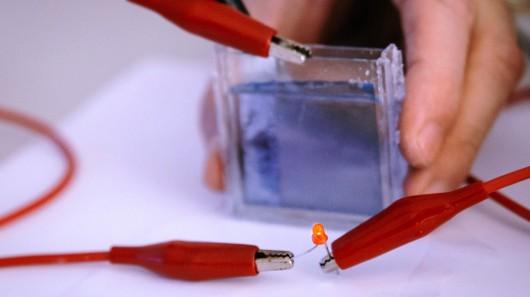
Professor Sun Xiaowei and colleagues at NTU have developed a self-powered smart window that is bi-functional. It can not only tint itself blue at the flip of a switch, but also act as a transparent electrochemical battery that can slowly charge itself by absorbing oxygen from it surroundings.
The window consists of two glass panes connected by electrical cables, with an oxygen-carrying liquid electrolyte in between them. The panes are wrapped inside a transparent conductive coating which is attached to an aluminum foil on one side and coated with an oxygen-sensitive blue dye on the other.
For more detail: Self-tinting “breathing” window doubles as a transparent battery
-
How does the smart window tint itself?
The window tints itself blue by interacting with an oxygen-sensitive blue dye when triggered. -
Does the window require an external power source?
No, the device functions without an external power source and recharges on its own. -
What allows the window to charge itself?
The window charges by absorbing oxygen from its surroundings through an electrochemical process. -
What materials are inside the window structure?
The structure contains two glass panes connected by cables with a liquid electrolyte between them. -
How is the transparent conductive coating applied?
The coating wraps around the panes and attaches to aluminum foil on one side. -
What color does the window turn when active?
The window turns blue to partially block incoming light. -
Who developed this technology?
Professor Sun Xiaowei and colleagues at Nanyang Technological University in Singapore developed it.