Summary of RK3568 DEVELOPMENT BOARD FEATURES VOICE NOISE REDUCTION
Geniatech’s RK3568 development board upgrades the RK3566 with an Arm Cortex-A55, Mali-G52 GPU, 0.8-TOPS NPU, extra I/O, enhanced camera and VPU capabilities, and 2-way dual-mic noise reduction. It supports 4Kp60 decoding, 1080p60 encoding, MIPI CSI2, multiple storage options, wireless connectivity, HDMI/eDP outputs, M.2 expansion, and runs Android 11 or Linux.
Parts used in the RK3568 development board:
- RK3568 SoC (Arm Cortex-A55)
- Mali-G52 GPU
- 0.8-TOPS NPU
- 4GB LPDDR4
- Up to 128GB eMMC 5.1
- MicroSD slots (up to 512GB, up to 2 slots)
- 802.11a/b/g/n/ac WiFi module with Bluetooth 5.0
- RF tuner input with ATSC
- GTIoT interface (for Z-Wave, ZigBee, LoRa, GPS, WiFi, BT 5.0, LTE)
- Pair of antenna mounts
- HDMI 2.1 output port
- HDMI input port
- eDP 1.3 port
- Dual-channel 24-bit LVDS via MIPI-DSI
- Dual mic matrix (2-way microphone array)
- SPDIF audio
- 4-lane MIPI-CSI camera interface
- M.2 slot with PCIe 3.0 (for scalable/wireless storage)
- 12V/2A power input jack
- Industrial-grade motherboard
- Operating system support: Android 11 or Linux
Geniatech’s RK3568 development board is a slight update in its RK3566 board. The RK3568 board comes with an Arm Cortex-A55 core and a Mali-G52 GPU for power graphical processing. Both the boards are the latest AIoT boards from Rockchip, but the RK3568 features some extra I/O ports in respect to RK3566.
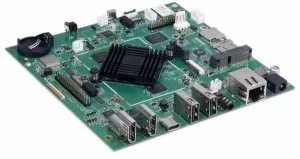
The RK3568 as well RK3566 development boards are equipped with its industrial-grade motherboard for stable continuous operation. VPU features video decoding with 4Kp60 H.264 and H.265 capacity and video encoding with 1080p60 H.264 and H.265 capacity. The camera I/F comes with 8M ISP with high-dynamic-range imaging. RK3568 and RK3566 both consist of MIPI CSI2 functioning at 2.5 Gbps per lane and digital video port camera support with BT.656/601/1120.
The RK3568 development board comes with voice noise reduction technology with a 2-way microphone and double MIC matrix for noise reduction and sound detection to be more efficient. One of the microphones picks up the voice including the ambient noise, whereas the second mic far from the user just picks the ambient noise. Hence, the ambient noise from the second mic is used to reduce the noise picked from the first mic. This allows significant noise reduction.
Technical Specifications Of RK3568 Development Board
- Mali-G52 GPU and 0.8-TOPS NPU
- Storage of 4GB LPDDR4 and Up to 128GB eMMC 5.1
- MicroSD slot up to 512GB up to 2 slots
- 802.11a/b/g/n/ac with Bluetooth 5.0 technology
- RF tuner input featuring ATSC
- GTIoT interface for Z-Wave, ZigBee, LoRa, GPS, WiFi, BT 5.0, or LTE
- Pair of antenna mounts
- Ports for HDMI 2.1 out port, HDMI in port, and eDP 1.3
- Dual-channel and 24-bit LVDS through MIPI-DSI
- Dual mic matrix with noise reduction
- SPDIF audio and 4-lane MIPI-CSI
- Scalable using M.2 slot with PCIe 3.0 and wireless storage support
- Power rating of 12V/2A input jack
- Operating system supporting Android 11 or Linux
Read more: RK3568 DEVELOPMENT BOARD FEATURES VOICE NOISE REDUCTION
- What CPU and GPU does the RK3568 development board use?
The RK3568 uses an Arm Cortex-A55 CPU and a Mali-G52 GPU. - Does the RK3568 board include an NPU?
Yes, it includes a 0.8-TOPS NPU. - What video decoding and encoding capabilities does the RK3568 have?
It supports 4Kp60 H.264 and H.265 decoding and 1080p60 H.264 and H.265 encoding. - How does the RK3568 implement noise reduction for voice?
It uses a dual mic matrix where one mic captures voice plus ambient noise and the second mic captures ambient noise to reduce noise from the first mic. - What camera interfaces are supported on the RK3568?
It supports MIPI CSI2 at 2.5 Gbps per lane and digital video port camera support with BT.656/601/1120 plus 4-lane MIPI-CSI. - What storage options are available on the RK3568 development board?
It offers 4GB LPDDR4, up to 128GB eMMC 5.1, microSD slots up to 512GB (up to 2 slots), and an M.2 slot with PCIe 3.0 for expansion. - Which wireless and network features does the RK3568 provide?
It provides 802.11a/b/g/n/ac WiFi with Bluetooth 5.0, RF tuner input with ATSC, GTIoT interface for Z-Wave, ZigBee, LoRa, GPS, and LTE, and antenna mounts. - What display and audio outputs are available on the RK3568?
It includes HDMI 2.1 out, HDMI in, eDP 1.3, dual-channel 24-bit LVDS via MIPI-DSI, and SPDIF audio. - What power input does the RK3568 require?
The board requires a 12V/2A input jack. - Which operating systems are supported on the RK3568 development board?
The board supports Android 11 and Linux.