Summary of PIC32 Bluetooth Starter Kit; DM320018
The DM320018 PIC32 Bluetooth Starter Kit enables communication with smart devices using the PIC32MX270F256D MCU and FLC-BTM805 dual-mode Bluetooth module. It includes Cree multi-color LEDs, standard LEDs, push buttons, a 3-axis accelerometer, and a temperature sensor. The board supports host, device, and debugging modes via specific USB ports and can be powered through USB or VBUS.
Parts used in the DM320018 PIC32 Bluetooth Starter Kit:
- PIC32MX270F256D microcontroller
- FLC-BTM805 dual-mode Bluetooth HCI module
- Cree high output multi-color LED
- Three standard single color LEDs
- Five push buttons
- Integrated 3-axis accelerometer
- Temperature sensor
- PIC24FJ256GB106 USB microcontroller
The DM320018 PIC32 bluetooth starter kit comes with demonstration code that allows it to communicate with smart devices that are bluetooth enabled. It features the PIC32MX270F256D MCU for central processing and the FLC-BTM805 dual-mode Bluetooth HCI module. The kit also contains Cree high output multi-color LED, three standard single color LEDs for display, five push buttons for user defined inputs, integrated 3-axis accelerometer and temperature sensor for applications intended by the user.
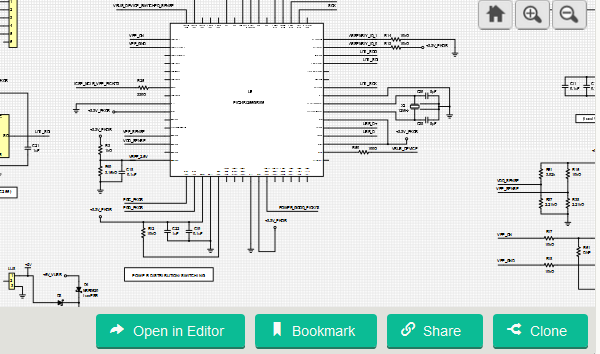
The development board in this starter kit has the PIC32MX270F256D microcontroller as its main component. All peripherals found in this development board are attached in the PIC32MX270F256D microcontroller. One of the peripherals is the low cost FLC-BTM805 bluetooth HCI module which allows devices to transmit or receive data from the microcontroller. The bluetooth module supports BT2.1 and later that has an HCI interface. It also supports Enhanced Data Rate (EDR) and can communicate with a data rate up to 3Mbps. Other peripherals just like the switches, LEDs, 3D accelerometer, temperature sensor, etc. are used for application development purposes.
The development board can run in three modes; host mode, device mode, and debugging mode. To operate in host mode, connect the device to the Type-A connector, port J1. To switch into device mode, connect the board to the host through port J2. The starter kit includes a PIC24FJ256GB106 USB microcontroller for debugging over USB. To select this mode, connect the starter kit to port J7. The board in this starter kit can be powered by connecting USB power to port J7 or apply VBUS (+5V) power to the micro-B USB connector found in the board.
For more detail: PIC32 Bluetooth Starter Kit; DM320018
- How does the kit communicate with smart devices?
The kit uses demonstration code with the FLC-BTM805 dual-mode Bluetooth HCI module to communicate with bluetooth enabled smart devices. - What is the main processing component of the development board?
The PIC32MX270F256D microcontroller serves as the central processing unit for all peripherals on the board. - Can the Bluetooth module support Enhanced Data Rate?
Yes, the FLC-BTM805 module supports Enhanced Data Rate (EDR) and communicates at data rates up to 3Mbps. - How do I operate the board in host mode?
To operate in host mode, connect the device to the Type-A connector located at port J1. - Which port should I use to switch into device mode?
Connect the board to the host through port J2 to switch into device mode. - What component is used for debugging over USB?
The starter kit includes a PIC24FJ256GB106 USB microcontroller for debugging over USB when connected to port J7. - How can the board be powered?
The board can be powered by connecting USB power to port J7 or applying VBUS (+5V) power to the micro-B USB connector.