


Summary of pic18f2550 Microcontroller Project Board
The PIC18F2550 Project Board is a student development platform for microcontroller-based instrumentation. It integrates a PIC18F2550 MCU, dual ADC options (sigma-delta and 6-channel), LCD connectors, onboard USB, and flexible power management. The design supports easy code programming via an ICSP header and allows students to build signal conditioning boards that plug directly into the main unit for rapid prototyping.Parts used in the PIC18F2550 Project Board:
- PIC18F2550 Microcontroller Unit
- External Crystal Oscillator
- LTC2400 or LTC2420 Sigma-Delta Converter
- 6-Channel 10-bit ADC
- Text LCD Connector (JR1)
- GLCD Connector (JF1)
- Type B USB Port
- Low Dropout Regulator
- Rechargeable Battery (BT1)
- LM336 Voltage Reference
- ICSP Header (J1)
- Jumper for Noise Rejection (J3)
The new PIC18F2550 Project Board was designed as the development platform for student projects.
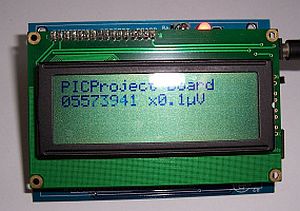
The board features
MCU: PIC18F2550 with external xtal,
ADC: one channel 0-2.5V sigma-delta converter, Linear Technology LTC2400/LTC2420,
6-channal 10-bit ADC 0-5V,
Display: Two connectors for text LCD or GLCD,
USB: onchip USB port with type B connector,
Power supply: onboard low dropout regulator, rechargeable battery,
Code programming: 10-pin header for In Circuit Loader.
The board platform is suitable for developing the microcontroller based instrumentation. Students may build the signal conditioning board, plugs it to PIC project board, develops the code and programs it with loader cable easily.
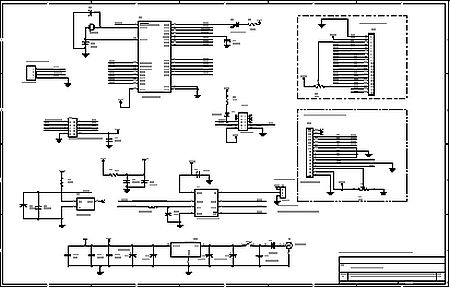
Hardware
The MCU is 28-pin PIC18F2550 with external xtal as the option. We can use internal oscillator. The loader uses only three pins, PGD, PGC and MCLR. J1 is ICSP header, we can plug it to the application board for both code loading and running. The user I/O ports is 6-channel analog input RA0-RA5. PORTB, RB0-RB7 is for LCD interface. User can choose either text LCD at JR1 connector or GLCD at JF1 connector. PORTC, RC0-RC2 is used to interface the LTC2400/LTC2420 SPI bus, sigma delta converter. RC4 and RC5 is USB port signal. RC6 is also available at J2. RC7 is debug LED. J1 is ICSP header. D2 protects VCC from high voltage programming at MCLR pin. U2 can be 20-bit or 24-bit resolution, sigma-delta converter, LTC2420 or LTC2400. J3 is jumper for selecting rejection of the common mode noise frequency, 50Hz or 60Hz. The reference voltage, +2.5V is generated by U3 LM336. The board can be powered by rechargeable battery, BT1.
For more Detail: pic18f2550 Microcontroller Project Board
- What is the primary purpose of this board?
The board is designed as a development platform specifically for student projects involving microcontroller-based instrumentation. - Can I use the internal oscillator instead of an external one?
Yes, while the board features an external crystal option, the internal oscillator can also be used. - How many pins does the loader require for programming?
The loader uses only three pins: PGD, PGC, and MCLR. - Which ports are assigned for the LCD interface?
PORTB, specifically RB0 through RB7, is used for the LCD interface. - How do I select between 50Hz and 60Hz noise rejection?
You can select the rejection frequency using jumper J3. - What component generates the +2.5V reference voltage?
The LM336 component, labeled U3, generates the +2.5V reference voltage. - Is it possible to power the board with a battery?
Yes, the board can be powered by the onboard rechargeable battery BT1. - Which ports handle the USB signals?
RC4 and RC5 are used for the USB port signals.
Related projects
Pinguino Project: A PIC Microcontroller Based Arduino
This is a complete tutorial to make a PIC Microcontroller based Arduino. This is a complete tutorial to make PIC microcontroller based...
Audio, Sound & Radio · PIC18F2550LM386 based stereo audio amplifier with digital volume control using PIC18F2550
Due to its simplicity (requires minimum external components) and high availability, LM386 is very popular among hobbyists for use in low-voltage audio...
Meters & Test Instruments · PIC18F2550Harmonic Distortion Meter using PIC18F2550
The 3rd harmonic distortion meter has been designed for measuring the quality of AC supply. The meter is built with a PIC18F2550...
LCD & Display ProjectsLeveraging Blockout Banners for Effective Electronics and Tech Product Displays
Blockout banners have become a popular and effective tool for displaying electronics and tech products in various settings, from trade shows and...
LCD & Display Projects · PIC18F4520Interfacing PIC18F4520 microcontroller with an HD44780 LCD
Introduction Being able to display data from a microcontroller visually has many advantages. It allows for menus, status indicators, and instructions to...
LCD & Display ProjectsVideo Project Development in the Midst of an Impromptu Online Semester
Receiving robot parts in the mail was an unexpected conclusion to the Winter 2020 semester for students. However, when faced with a...

Ibrar Ayyub
I am an experienced technical writer holding a Master's degree in computer science from BZU Multan, Pakistan University. With a background spanning various industries, particularly in home automation and engineering, I have honed my skills in crafting clear and concise content. Proficient in leveraging infographics and diagrams, I strive to simplify complex concepts for readers. My strength lies in thorough...