


Summary of PIC RGB Power Board using PIC12F629 microcontroller
Power Pic RGB is a circuit generating random RGB colors and fading between them using a 3W LED. The project successfully implemented a fading algorithm to drive a Prolight 3 Watt RGB LED housed in a white globe. The design utilizes a PIC12F629 microcontroller, three BS170 MOSFETs for driving the LED channels, and a 7805 5V 1A voltage regulator with a heatsink.Parts used in the Power Pic RGB:
- PIC12F629 microcontroller
- 3W RGB LED (Prolight)
- Three BS170 MOSFET transistors
- 7805 5V 1A voltage regulator
- Heatsink
- White globe enclosure
Description
Power Pic RGB is a circuit that generates random RGB colors using a powerful 3W RGB LED and fades
between them.
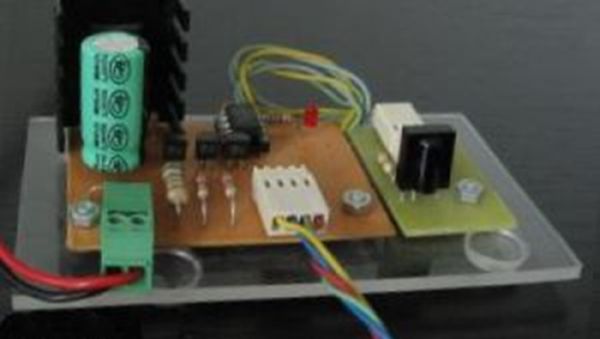
The initial project goal was to develop the fading algorithm which was successfully achieved. This time the idea was to drive a Prolight 3 Watt RGB LED and place it inside a nice white globe! On the right is a picture of the first prototype board eith a small board attached that doesn't belong to this project.
Design and Implementation
The circuit is basically the same with the addition of 3 BS170 mosfet transistors to drive the LED and a powerful 5V regulator. The PIC is the same but the code has a small big difference, explained below!
Schematic
From left to right we can see the power supply based on a 7805 5V 1A regulator, the microcontroller and finally on the right the three mosfets that will drive the LED. Click the image to enlarge.

Each mosfet can drive a maximum 600mA through its drain but according to Prolight each LED (red, green and blue) can only sustain 300mA which makes this mosfet perfect for the job.
Summing the 3 LED currents we get 900mA not counting the current consumed by the PIC and the 7805 itself which should be around 3 or 4 mA. The 7805 is able to supply 1A of current with a proper Heatsink.
For more detail: PIC RGB Power Board using PIC12F629 microcontroller
Quick Solutions to Questions related to Power Pic RGB:
- What is the main function of the Power Pic RGB circuit?
The circuit generates random RGB colors using a powerful 3W RGB LED and fades between them. - How many MOSFETs are used to drive the LED?
The circuit uses three BS170 MOSFET transistors to drive the LED. - Can the BS170 MOSFET handle the required current?
Yes, each MOSFET can drive a maximum of 600mA, which is sufficient since each LED color sustains only 300mA. - What type of regulator is used for power supply?
A 7805 5V 1A regulator is used as the power supply component. - Does the 7805 regulator require a heatsink?
Yes, the 7805 requires a proper heatsink to supply 1A of current effectively. - What microcontroller is used in this project?
The project uses the PIC12F629 microcontroller. - How much total current do the three LEDs consume?
Summing the three LED currents results in 900mA. - Is the code different from previous versions?
Yes, the code has a small big difference compared to previous iterations to explain the new implementation.
Related projects
RGB LED PWM Driver for High Power 350mA LEDs using PIC12F629
Description This project combines a PIC and three constant current 'buck' converters to produce an RGB LED controller that will operate with...
Communication & Interfacing · PIC12F629Wireless controlled lightdimmer using PIC12F629
The meaning from this design is to build it in -i.e. a shaded lamp- and to switch this lamp on and off...
LED Projects · PIC12F629Navigation Lights for Models for PIC12F629
Description This project was inspired from a post on the Picprojects forum where a member had adapted the RGB Moodlight project for...
Power & BatteryImplementing Smart Cooling Control for Induction Heaters with PIC Microcontrollers
Today, induction heating powers countless industrial processes like melting, heat treatment, and welding, plus everyday appliances like cooktops. Its key advantages? High...
Power & BatteryIntegrating Solar Power: Microcontroller-Based Approaches for Domestic Electricity
Abstract: Microcontrollers have found extensive application in endeavors aimed at reducing power consumption. The availability of microcontroller development tools has made them...
Power & BatteryEfficient Power Generation with Microcontroller-Controlled Thermoelectric Generators
INTRODUCTION The global demand for electrical energy continues to rise steadily, necessitating a shift towards renewable energy sources as traditional fossil fuels...

Ibrar Ayyub
I am an experienced technical writer holding a Master's degree in computer science from BZU Multan, Pakistan University. With a background spanning various industries, particularly in home automation and engineering, I have honed my skills in crafting clear and concise content. Proficient in leveraging infographics and diagrams, I strive to simplify complex concepts for readers. My strength lies in thorough...