
Summary of MPS TAPS EPC FOR 48V GAN DC-DC CONVERTER
Monolithic Power Systems introduced a family of 48 V to 6 V digital DC-DC power modules using EPC eGaN FETs, starting with the MPC1100-54-0000. The LLC 10:1 module delivers 300 W from a 27 mm x 18 mm x 6 mm package, achieving over 97% efficiency and up to 1700 W/in3 power density. The design enables high-frequency secondary stages positioned closer to xPU/ASIC/GPU, reducing distribution loss fourfold versus 48 V–12 V STC topologies, making it well suited for high-density data center, AI, and gaming applications.
Parts used in the MPC1100-54-0000:
- MPC1100-54-0000 module (48 V to 6 V LLC DC-DC power module)
- eGaN FETs from Efficient Power Conversion (EPC)
- LLC converter topology components (transformer, resonant network)
- Digital controller from Monolithic Power Systems
- Gate drive circuitry compatible with 5 V gate operation
- High-frequency secondary stage components for point-of-load placement
- Package/PCB measuring 27 mm x 18 mm x 6 mm
The combination of MPS (Monolithic Power Systems) controllers with ultra-efficient eGaN® FETs from EPC (Efficient Power Conversion) enable best-in-class power density of 1700 W/in3 in high efficiency, low cost LLC DC-DC Conversion
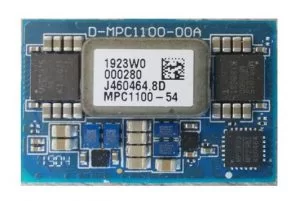
Monolithic Power Systems, Inc. (MPS), a leading company in high-performance power solutions, announced the launch of a new family of 48 V – 6V digital DC-DC power modules for 48 V Data Center Solutions, utilizing eGaN® transistors from Efficient Power Conversion (EPC) Corporation. These power modules target applications for high-density computing and data centers, artificial intelligence, machine learning, and multi-user gaming.
MPC1100-54
- 48 V – 6 V
- LLC 10:1
- 300 W
- 27 mm x 18 mm
- 1700 W/in3
The MPC1100-54-0000 is the first in the new product family that will include modules in an LLC topology that utilize eGaN FETs to achieve an overall efficiency above 97% in a footprint of only 27 mm x 18 mm x 6 mm for 48 V – 6 V conversion. A key advantage of 48 V – 6 V front-end conversion includes the enabling of a high-frequency secondary stage that is small enough to be placed much closer to the xPU/ASIC/GPU to reduce the power distribution loss by 4x compared to the commonly used STC topology for 48V – 12V conversion.
For high-density server applications, record power density and efficiency can be achieved with simple, low-cost topologies such as an LLC DC-DC converter. eGaN FETs are well suited for LLC converters due to their combined low gate charge with 5 V gate operation that yields very low gate power consumption, ultra-low on-resistance, and low output capacitance charge.
Read more: MPS TAPS EPC FOR 48V GAN DC-DC CONVERTER
- What is the input and output voltage range of the MPC1100-54-0000?
The module converts 48 V input to 6 V output. - What power level does the MPC1100-54-0000 provide?
It provides 300 W output power. - What efficiency does the module achieve?
The module achieves overall efficiency above 97%. - What is the power density of the MPC1100-54-0000?
It achieves a power density of 1700 W per cubic inch. - What is the physical size of the MPC1100-54-0000 module?
The package measures 27 mm x 18 mm x 6 mm. - Why are eGaN FETs used in this LLC converter?
eGaN FETs offer low gate charge with 5 V gate operation, ultra-low on-resistance, and low output capacitance charge, making them well suited for LLC converters. - How does 48 V to 6 V front-end conversion benefit power distribution?
It enables a high-frequency secondary stage to be placed closer to xPU/ASIC/GPU, reducing power distribution loss by four times compared to 48 V to 12 V STC topology. - What applications target this power module family?
Applications include high-density computing, data centers, artificial intelligence, machine learning, and multi-user gaming.