
Summary of MITSUBISHI ELECTRIC TO LAUNCH MELDIR THERMAL DIODE INFRARED SENSOR
Mitsubishi Electric launched the MelDIR, a compact thermal sensor for security and HVAC systems. It distinguishes humans from other heat sources and identifies behaviors like walking or raising hands. Using technology from the ALOS-2 satellite, it offers 10x higher pixel resolution (80×32) and five times better thermal sensitivity than standard thermopile sensors. Its miniaturized design saves space while maintaining high accuracy through proprietary vacuum-sealing and noise-reduction techniques.
Parts used in the MelDIR project:
- Thermal diode infrared sensor
- Compact InfraRed Camera (CIRC)
- High-spec amplifier
- Microfabrication technique supporting legs
- Proprietary chip-scale vacuum-sealing technology
Accurately detects heat to identify types of heat sources and specific human behavior
Mitsubishi Electric Corporation announced that it will launch the Mitsubishi Electric Diode InfraRed sensor (MelDIR), a thermal sensor for applications in the fields of security, heating, ventilation and air conditioning (HVAC) and smart buildings, on November 1. MelDIR accurately distinguishes between humans and other heat sources and enables the identification of specific human behavior, such as walking, running or raising hands. It delivers high-pixel, high-thermal-resolution images using thermal diode infrared sensor technology that Mitsubishi Electric developed for the Advanced Land Observing Satellite-2 “DAICHI-2” (ALOS-2).
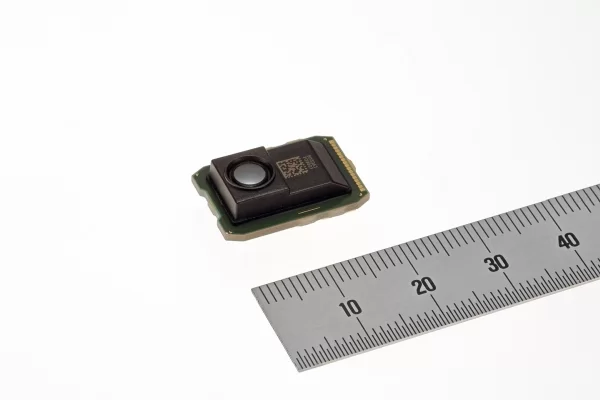
Features
1) High-pixel, high-thermal-resolution images
- 10 times higher pixel resolution (80×32 pixels) and five times higher thermal resolution of 100 mK, or 0.1 degree Celsius, compared to 16×16 pixel thermopile sensors now sold in the market, using thermal diode infrared sensor technology installed in the Compact InfraRed Camera (CIRC) for observing the earth with the ALOS-2, which Mitsubishi Electric delivered to the Japan Aerospace Exploration Agency in 2014 and is now in operation.
- Supporting legs, made extra thin thanks to microfabrication technique, convey energy efficiently without releasing heat, enabling more (smaller) pixels to be used for increased resolution.
- Electrical noise minimized by mounting thermal diode and high-spec amplifier close to each other on same chip, helping to maintain accuracy and achieve high thermal resolution.
- Enables highly detailed thermal images for distinguishing between humans and other heat sources and for identifying specific human behavior, such as walking, running or raising hands.
2) Compact, space-saving sensor developed with proprietary chip-scale vacuum-sealing technology
- Package is 80 percent smaller than that of existing sensors thanks to new packaging technology.
- Proprietary chip-scale packaging technology and vacuum-sealing technology enable sensor to be vacuum sealed (without using conventional ceramic package) to avoid heat radiation and achieve high thermal resolution.
Read more: MITSUBISHI ELECTRIC TO LAUNCH MELDIR THERMAL DIODE INFRARED SENSOR
- What specific human behaviors can MelDIR identify?
The sensor can identify behaviors such as walking, running, or raising hands. - How does the pixel resolution compare to existing thermopile sensors?
MelDIR has 10 times higher pixel resolution at 80×32 pixels compared to standard 16×16 sensors. - Does the sensor minimize electrical noise?
Yes, mounting the thermal diode and high-spec amplifier close together on the same chip minimizes electrical noise. - How much smaller is the MelDIR package than existing sensors?
The package is 80 percent smaller than that of existing sensors due to new packaging technology. - Can the sensor distinguish between humans and other heat sources?
Yes, it accurately distinguishes between humans and other heat sources using high-pixel, high-thermal-resolution images. - What technology was used to develop the sensor core?
It uses thermal diode infrared sensor technology developed for the Advanced Land Observing Satellite-2 DAICHI-2.