Summary of Microchip LoRa Network Module
Microchip Technology Inc. has introduced the RN2483, a LoRa-based wireless module designed for IoT and M2M applications. It offers over 10 miles of range, more than 10 years of battery life, and supports millions of sensor nodes. Operating at 433/868 MHz, this compact module includes 14 GPIOs, integrates the LoRaWAN protocol stack, and features AES-128 encryption for secure communication.
Parts used in the RN2483 Module:
- LoRa technology low-data-rate wireless networking standard
- 433/868 MHz Radio Module
- LoRaWAN™ protocol stack
- Microcontroller with UART interface
- AES-128 encryption security feature
- Spread-spectrum base modulation system
- ASCII command interface
- LoRa Alliance infrastructure components
Microchip Technology Inc., has announced the first in a series of modules for the LoRa technology low-data-rate wireless networking standard. The system is designed to allow Internet of Things (IoT) and Machine-to-Machine (M2M) wireless communication offering a range of more than 10 miles (suburban), a battery life of greater than 10 years, and the ability to connect millions of wireless sensor nodes to LoRa technology gateways. The 433/868 MHz RN2483 is a European R&TTE Directive Assessed Radio Module measuring 17.8 x 26.3 x 3 mm and with 14 GPIOs to provide connections and control for a large number of sensors and actuators.
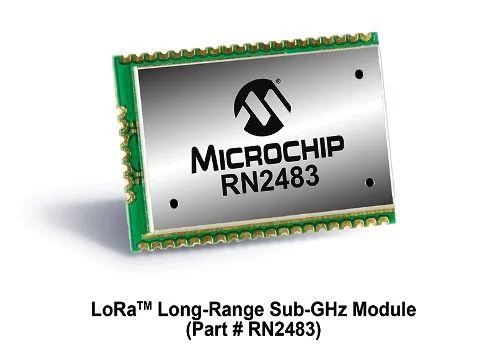
The RN2483 is also supplied with the LoRaWAN™ protocol stack, allowing connection with the LoRa Alliance infrastructure—including both privately managed local area networks (LANs) and telecom-operated public networks—to create Low Power Wide Area Networks (LPWANs) with nationwide coverage. This stack integration also enables the module to be used with any microcontroller with a UART interface. The RN2483 also uses Microchip’s simple ASCII command interface for easy configuration and control.
The LoRa technology uses a spread-spectrum base modulation that is capable of demodulation with a 20 dB below noise level. This enables high sensitivity with robust network links, improves network efficiency and eliminates interference. The LoRaWAN protocol’s star topology eliminates synchronization overhead and hops, compared to mesh networks, which reduces power consumption and enables multiple concurrent applications to run on the network. LoRa technology also has a much longer range than other wireless protocols, enabling the RN2483 to operate without repeaters. In comparison to 3G and 4G cellular networks, it is far more scalable and cost effective for embedded applications. The RN2483 uses AES-128 encryption for network security.
For more detail: Microchip LoRa Network Module
- What is the primary purpose of the RN2483 module?
The RN2483 is designed for Internet of Things and Machine-to-Machine wireless communication. - How long does the battery last on the RN2483?
The module offers a battery life of greater than 10 years. - Does the RN2483 support connection with existing LoRa networks?
Yes, it connects with LoRa Alliance infrastructure including private LANs and public networks. - Can the RN2483 operate without repeaters?
Yes, its long range allows it to operate without repeaters compared to other wireless protocols. - What type of encryption does the RN2483 use for security?
The module uses AES-128 encryption for network security. - How many GPIOs are available on the RN2483 module?
The module features 14 GPIOs to provide connections for sensors and actuators. - Is the RN2483 compatible with any microcontroller?
It can be used with any microcontroller that has a UART interface. - Why is LoRaWAN considered more cost-effective than 3G or 4G?
LoRa is far more scalable and cost-effective for embedded applications compared to cellular networks.