
Summary of Microchip aims at LED car lighting
Microchip's PIC16(L)F1769 microcontroller introduces the Programmable Ramp Generator (PRG), enabling two independent closed-loop channels for LED lighting. This core independent peripheral automates slope compensation to stabilize boost converters operating above 60% duty cycles. By integrating nine specialized power blocks, including COGs and high-speed comparators, the device reduces CPU load, allowing 8-bit MCUs to compete with faster 32-bit solutions in complex power applications.
Parts used in the PIC16(L)F1769 Microcontroller:
- Programmable ramp generator (PRG)
- Complementary waveform generator (COG)
- Op amps
- 10bit ADC
- 5bit DACs
- 10bit DACs
- 10bit PWMs
- 16bit PWMs
- High-speed comparators
- Two 100mA I/O pins
- Configurable logic cell (CLC)
- Data signal modulator (DSM)
- Zero crossing detector (ZCD)
Microchip has included a new power building block in a microcontroller aimed at LED lighting.
Called the PIC16(L)F1769, the family has the first PICs to offer two independent closed-loop channels.
The firm has steadily been introducing power control peripheral blocks over the last three years – so-called ‘core independent peripherals (CIPs), including for example its ‘complementary waveform generator’ (COG, see below) which produces non-overlapping waveforms to control synchronous power mosfets.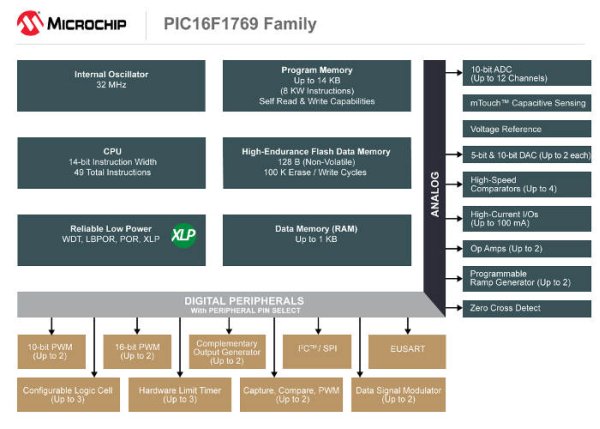 Its aim is to include peripherals which cut processing load in power applications, to allow its 8bit MCUs to compete with fast 32bit MCUs that implement everything in code, particularly for power engineers used to using hardware.
The latest block, bringing the total to nine including the COG, is called the ‘programmable ramp generator’ (PRG). It does what it says on the tin and makes analogue sawtooth waveforms for automating slope and ramp compensation on multiple independent power channels.
“In a boost converter, for example, when duty cycle gets above 60%, the duty cycle can start to oscillate. Slope compensation stabilises this,” Microchip business development manger Lucio Di Jasio told Electronics Weekly at Embedded World.
There are now so many of these peripherals that it is possible to design similar power converters with more than one topology using PIC MCUs.
In F1769, the firm, which has a love of three letter acronyms, has included: op amps, a 10bit ADC, 5bit DACs, 10bit DACs, 10bit PWMs, 16bit PWMs, high-speed comparators, two 100mA I/O pins, and these CIPs: two COGs, a PRG, a CLC (puddle-of-gates configurable logic cell), a DSM (data signal modulator) and a ZCD (zero crossing detector).
For more detail: Microchip aims at LED car lighting
- What is the primary function of the PRG in this microcontroller?
The programmable ramp generator makes analogue sawtooth waveforms for automating slope and ramp compensation on multiple independent power channels. - How does the PRG help in a boost converter?
Slope compensation stabilizes the duty cycle when it gets above 60% and starts to oscillate. - Can the PIC16(L)F1769 handle more than one power topology?
Yes, the inclusion of many peripherals allows designers to create similar power converters with more than one topology using these MCUs. - What is the main goal of introducing Core Independent Peripherals like the COG?
The aim is to cut processing load in power applications so that 8-bit MCUs can compete with fast 32-bit MCUs. - Does the PIC16(L)F1769 offer independent control channels?
Yes, this family has the first PICs to offer two independent closed-loop channels. - Which specific peripherals are included alongside the new PRG block?
The device includes op amps, ADCs, DACs, PWMs, comparators, I/O pins, CLC, DSM, and ZCD. - What type of waveforms does the complementary waveform generator produce?
The COG produces non-overlapping waveforms to control synchronous power mosfets. - Why might a power engineer prefer this hardware over code implementation?
Power engineers used to using hardware may prefer this because these peripherals cut processing load compared to implementing everything in code.