
Summary of Make high-quality double-sided PCBs – at home
Summary: Making your own PCBs lets you prototype quickly—assembling a board in an evening versus waiting one to four weeks for commercial fabrication. DIY avoids size-based commercial pricing for sparse or oversized layouts and offers learning, skill development, and craftsmanship satisfaction despite a learning curve and significant time investment.
Parts used in the Project:
- Printed circuit board substrate (blank copper-clad board)
- Drill bits for PCB holes
- Solder mask or resist materials
- Etchant solution
- Protective gloves and safety equipment
- Solder and soldering iron
- Electronic components to populate the PCB (ICs, resistors, capacitors, connectors, etc.)
- Cleaning materials (isopropyl alcohol, scrub pads)
- Artwork or toner transfer materials for PCB traces
Why make your own printed circuit boards when you can get them commercially made for low cost? For one, it can take one to four weeks to receive the boards. For prototyping, this can be a major hurdle. Each design iteration will then take a month or more, and a project may need many months to get done. The DIYer can fab the board and assemble everything in one evening. That advantage is really hard to beat.
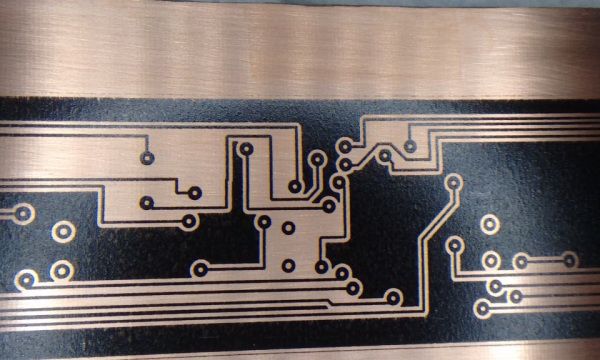
Besides time, there are other reasons to make your own board. Commercial services charge by board size, not complexity. Larger boards will cost more even if they are completely blank. I once had to make an oversized PCB because the parts had to be spaced far apart. It was a very sparse board, but getting it made from even the cheapest commercial source would have been expensive.
Having said that, this is not really about saving time or money. If the phrase “building your own” does not excite you, then read no more. Building a board may not take two whole weeks, but it will take many hours. Like in everything, there is a learning curve. It’s not going to work the first time. Remember, we are talking about building a near-professional quality board, not something that is thrown together to check the functionality of a circuit. If the process itself is an unpleasant experience then it will not be worth any amount of time or money saved. The reason people build instead of buy is because they enjoy learning and perfecting new skills. If you are detail-oriented, have lots of patience, and take pride in craftsmanship, then this might be for you.
For more detail: Make high-quality double-sided PCBs – at home
- Why make your own printed circuit boards instead of ordering commercially made ones?
To prototype much faster (one evening versus one to four weeks), avoid size-based commercial costs for sparse boards, and enjoy learning and craftsmanship. - How long do commercial PCB services typically take to deliver boards?
They can take one to four weeks to deliver boards. - Can ordering commercial PCBs be expensive for large, sparsely populated boards?
Yes, commercial services charge by board size, so large but sparse boards can be expensive. - Will building your own boards save time during prototyping?
Yes, a DIYer can fab and assemble a board in one evening, speeding up design iterations. - Is making your own PCBs always worth the effort to save money or time?
Not necessarily; it requires many hours, a learning curve, and may not be worth it if you do not enjoy the process. - What personal qualities make someone suited to building their own PCBs?
Being detail-oriented, patient, enjoying learning, and taking pride in craftsmanship. - Will the process work perfectly the first time?
No, there is a learning curve and it is not likely to work perfectly the first time. - Does the article recommend building only quick throwaway test boards?
No, the article discusses building near-professional quality boards, not just throwaway test circuits.

