
Summary of LTM8003 – 40VIN, 3.5A Step-Down Module Regulator
The LTM8003 is a compact 40V, 3.5A step-down μModule regulator featuring an integrated controller, power switches, inductor, and support components. It operates from 3.4V to 40V input, delivering 0.97V to 18V output with selectable frequencies up to 3MHz. Designed for high-density applications like automotive and industrial systems, it includes FMEA-compliant protection and fits into a tiny BGA package requiring only external filter capacitors.
Parts used in the LTM8003 Project:
- LTM8003 Step-Down μModule Regulator
- Input Filter Capacitors
- Output Filter Capacitors
- Single Resistor (for voltage/frequency setting)
Features
- Complete Step-Down Switch Mode Power Supply
- Wide Input Voltage Range: 3.4V to 40V
- Wide Output Voltage Range: 0.97V to 18V
- Wide Temperature Range: –40°C to 150°C (H-Grade)
- 3.5A Continuous Output Current, 6A peak
- FMEA Compliant Pinout Output Stays at or Below Regulation Voltage During Adjacent Pin Short or if a Pin Is Left Floating
- Selectable Switching Frequency: 200kHz to 3MHz
- External Synchronization
- Low Quiescent Current: 25μA (5VOUT)
- Programmable Soft-Start
- Tiny, Low Profile 6.25mm × 9mm × 3.32mm RoHS Compliant BGA Package
Description
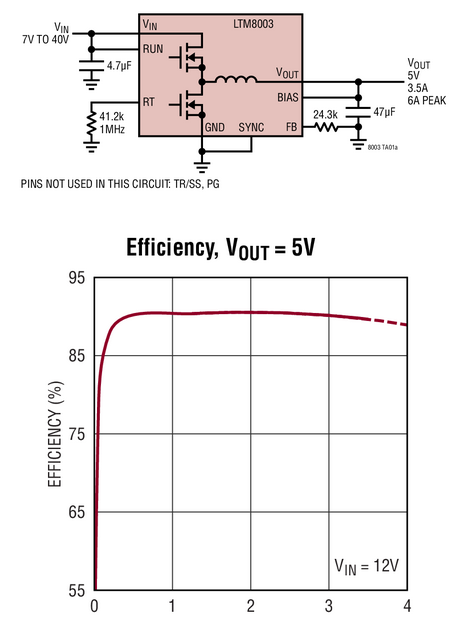
The LTM®8003 is a 40VIN, 3.5A step-down μModule® (power module) regulator. Included in the package are the switching controller, power switches, inductor, and all support components. Operating over an input voltage range of 3.4V to 40V, the LTM8003 supports an output voltage range of 0.97V to 18V and a switching frequency range of 200kHz to 3MHz, each set by a single resistor. Only the input and output filter capacitors are needed to finish the design.
The low profile package enables utilization of unused space on the bottom of PC boards for high density point of load regulation. The LTM8003 is packaged in a thermally enhanced, compact over-molded ball grid array (BGA) package suitable for automated assembly by standard surface mount equipment. The LTM8003 is RoHS compliant.
Applications
- Automotive Battery Regulation
- Power for Portable Products
- Distributed Supply Regulation
- Industrial Supplies
- Wall Transformer Regulation
For More Details: LTM8003 – 40VIN, 3.5A Step-Down μModule Regulator
- What is the maximum input voltage for the LTM8003?
The device supports an input voltage range of 3.4V to 40V. - Can the switching frequency be adjusted externally?
Yes, the switching frequency is selectable between 200kHz and 3MHz using a single resistor. - How much continuous output current does the regulator provide?
It provides 3.5A of continuous output current with a 6A peak capability. - Does the LTM8003 require many external components?
No, only the input and output filter capacitors are needed as all other components are included in the package. - Is the LTM8003 suitable for automated assembly?
Yes, its thermally enhanced BGA package is suitable for standard surface mount equipment. - What happens if a pin is left floating or shorted?
The output stays at or below regulation voltage due to FMEA compliant pinout design. - What is the operating temperature range for the H-Grade version?
The wide temperature range extends from –40°C to 150°C. - Is the LTM8003 RoHS compliant?
Yes, the package is RoHS compliant.
