
Summary of Low-Power Barometric Pressure Sensor from Infineon Delivers New Levels of Accuracy for Mobile and Wearable Gadgets and IoT Devices
Infineon Technologies launched the DPS310, a miniature MEMS pressure sensor designed for mobile, wearable, and IoT devices. Offering ultra-high ±5cm resolution, it supports indoor navigation, floor detection, gesture recognition, and weather monitoring. Utilizing capacitive sensing rather than piezo-electric methods, it ensures stability across temperature fluctuations. The sensor features advanced automotive-grade semiconductor processes, resulting in a compact 2.0mm x 2.5mm x 1.0mm size and extremely low power consumption with an integrated FIFO buffer.
Parts used in the DPS310 Project:
- DPS310 Pressure Sensor
- MEMS (Micro Electro Mechanical Systems) component
- Capacitive sensing principle mechanism
- Advanced semiconductor process technologies
- Integrated FIFO buffer (storing 32 measurements)
Munich, Germany – February 26, 2015 – Infineon Technologies AG (FSE: IFX / OTCQX: IFNNY) has launched an ultra-high ±5cm resolution, miniature MEMS (Micro Electro Mechanical Systems) pressure sensor for use in mobile and wearable gadgets and IoT (Internet of Things) devices. The DPS310 is a low-power digital barometric pressure sensor that enables the development of new and enhanced navigation, location, well-being, gesture recognition and weather monitoring applications.
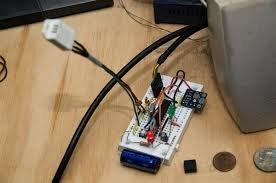
Delivering accurate and stable performance across a wide temperature range, the DPS310 is ideal for indoor navigation and assisted location applications – such as floor detection in shopping malls and parking garages– and outdoor navigation where it can help to improve navigation accuracy or support ‘dead reckoning’ when GPS signal is not available. In addition, the ability to provide accurate data for calculating elevation gain and vertical speed suits activity tracking in mobile and wearable health and sports gadgets, while ultra-precise pressure measurement opens up new possibilities for gesture recognition and the detection of rapid weather changes.
The Infineon DPS310 pressure sensor is based on the capacitive sensing principle rather than the piezo-electric principle employed in most other digital pressure sensors. This guarantees high precision across a broad range of temperatures even when temperature changes rapidly. This is clearly an advantage since the temperature inside a mobile device can change quickly due to several heat sources.
In high-precision mode the DPS310 can measure heights within ±5cm enabling the exact detection of transient states, which are the biggest challenges of indoor navigation. The high resolution of Infineon’ pressure sensor could help, for example, in identifying when a person is moving from one floor of a building to another and triggering the download of a new floorplan. High-accuracy height measurement is also required by sports and fitness applications that need to differentiate between the different types of ‘steps’ a wearer might be taking and the corresponding calorie ‘burn rate’.
For the new pressure sensor Infineon makes use of advanced semiconductor process technologies that were originally developed for the company’s automotive sensors. The sensors are highly reliable and, for example, integrated in safety applications such as airbags. These technologies contribute to both the small device size of 2.0mm x 2.5mm x 1.0mm and its low-power consumption. In low power mode the current consumption is only 3μA at one measurement per second, falling to just less than 1μA in standby mode. An integrated FIFO that stores the last 32 measurements helps to further reduce overall system power consumption by extending the time that a host processor can remain in sleep mode between sensor readouts.
For more detail: Low-Power Barometric Pressure Sensor from Infineon Delivers New Levels of Accuracy for Mobile and Wearable Gadgets and IoT Devices
-
What is the primary function of the Infineon DPS310?
It is a low-power digital barometric pressure sensor enabling navigation, location, well-being, gesture recognition, and weather monitoring applications. -
How does the DPS310 achieve high precision during rapid temperature changes?
It uses the capacitive sensing principle instead of the piezo-electric principle employed in most other digital pressure sensors. -
Can the sensor detect when a person moves between floors?
Yes, in high-precision mode it measures heights within ±5cm to identify transient states like moving from one floor to another. -
What are the physical dimensions of the DPS310 sensor?
The device size is 2.0mm x 2.5mm x 1.0mm. -
How much current does the sensor consume in low power mode?
Current consumption is only 3μA at one measurement per second in low power mode. -
Does the sensor include a feature to reduce host processor activity?
Yes, an integrated FIFO stores the last 32 measurements to extend the time a host processor can remain in sleep mode. -
Which technology was originally developed for automotive sensors and used here?
Advanced semiconductor process technologies originally developed for safety applications like airbags were utilized.