Summary of LicheePi Nano: high-performance SD card sized Linux board based on an ARM9 core
The Allwinner F1C100 SoC, based on the ARM9 architecture, powers the LicheePi Nano, a compact single-board computer designed for multimedia and embedded applications. While the A10 Cortex-A8 dominated tablets, the F series excels in vehicle systems and audio solutions. The LicheePi Nano integrates DDR memory, supports various display resolutions, and handles video decoding up to 720p within an SD card-sized form factor.
Parts used in the LicheePi Nano:
- Allwinner F1C100s ARM926EJS processor
- 32MB DDR integrated into SoC
- Micro SD card storage slot
- Optional 8M SPI flash
- 40-pin RGB LCD FPC connector
- SDIO WiFi module interface
- 2x SPI, 3x TWI (I2C), 3x UART interfaces
- 1x TV out and 2x TV in interfaces
- 2x PWM outputs
- 1x LRADC input
- 2x speaker outputs and 1x mic input
- 1x micro USB OTG port
The diffusion of the A10 Cortex A8 processor did not stop the ARM9 market of the Allwinner F series. Since its foundation, Allwinner has released several SoCs for use in Android tablets, as well as in smartphones and camera systems. The A10 was the most successful Soc of Allwinner. The chip was mainly used on Android and Linux keys, even with tablets under $ 150 such as Ainol Novo 7 Aurora (India). The processor supports a maximum resolution of 1920×1080 pixels, although it has often been used in tablets with resolutions of 1024×600 or 1280×800 pixels.
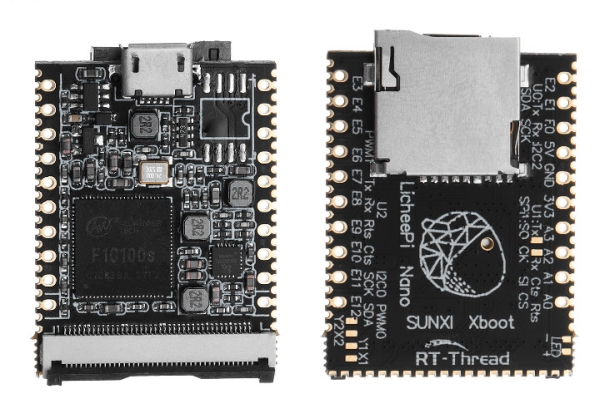
The F series finds application especially in multimedia systems for vehicles and various audio solutions. LicheePi Nano is a small Single Board Computer (SBC) which marries the configuration of the F1C100, in a form factor of the size of an SD card. It provides a full support[MP1] for LED and RGB displays. The F1C100 processor is based on the ARM9 CPU architecture with a high level of functional integration. F1C100 supports Full HD video playback, including H.264, H.263, MPEG1 / 2/4 decoders. The integrated audio codec and I2S / PCM interface enable the user for an excellent audio experience. The TV-IN and TV-OUT interfaces allow the use of video devices such as the camera and the TV.
The SoC implements two timers to provide the operating system’s scheduler interrupt. There are three type of DMA, each can support 8-bit/16-bit/32-bitdata width. Moreover, The DRAM Controller (DRAMC) provides an interface to support up to a 1G bits memory address space.
The specifications of the LicheePi Nano board are summarized in the following points:
- SoC- Allwinner F1C100s ARM926EJS processor clocked at up to 900MHz
- System Memory – 32MB DDR integrated into SoC
- Storage – Micro SD card, and optional 8M SPI flash (unpopulated in the photo above)
- Display I/F – 40-pin RGB LCD FPC connector supporting 272×480, 480×800, 1024×600 and other resolutions resistive and capacitive displays
- Video Decoding – H.264 / MPEG up to 720p
- I/Os via 2.54mm pitch through holes and 1.27mmm pitch castellated holes
- SDIO for WiFi module
- 2x SPI, 3x TWI (I2C),3x UART
- 1x TV out, 2x TV in
- 2x PWM
- 1x LRADC
- 2x speaker output, 1x mic input
- USB – 1x micro USB OTG port
- Power Supply
- Input 5V via micro USB port, 3.3 to 5V via pin
- Output – 3.3V, selectable input RTC voltage
- Power Consumption – 54mA (idle) with Linux, 250mA with display
- Temperature Range – Storage: -40~125°C; operating: -20 to 70°C
Read more: LicheePi Nano: high-performance SD card sized Linux board based on an ARM9 core
- What is the LicheePi Nano?
It is a small Single Board Computer that marries the configuration of the F1C100 in a form factor the size of an SD card. - Does the F1C100 support Full HD video playback?
The F1C100 supports Full HD video playback including H.264, H.263, and MPEG1/2/4 decoders. - How much system memory does the board have?
The board features 32MB of DDR memory integrated directly into the SoC. - Can the LicheePi Nano connect to a WiFi module?
Yes, it includes an SDIO interface specifically for connecting a WiFi module. - What is the maximum video resolution supported by the SoC?
The SoC supports video decoding up to 720p via H.264 and MPEG formats. - How is the device powered?
Power can be supplied via a 5V input through the micro USB port or 3.3 to 5V via pins. - What display resolutions are supported by the connector?
The 40-pin RGB LCD FPC connector supports resolutions such as 272×480, 480×800, and 1024×600. - Does the processor include timers for the operating system?
The SoC implements two timers to provide the operating system's scheduler interrupt.