


Summary of Interfacing Ultrasonic Distance Sensor : ASCII Output with PIC Microcontroller
This article explains how to interface a Rhydolabz Ultrasonic Distance Sensor with a PIC Microcontroller using USART. The sensor provides non-contact distance measurements from 2cm to 4m by transmitting ultrasonic bursts every 500ms and returning ASCII data representing the echo time in centimeters. It operates at 9600 baud, requires a 5V DC supply, and connects via its Signal pin to the microcontroller's RX pin.Parts used in the Ultrasonic Distance Sensor Interface Project:
- Rhydolabz Ultrasonic Distance Sensor with ASCII Output
- PIC Microcontroller
- USART communication module
- 5V DC Power Supply
In some of our projects, we may want to measure the distance of an object from a point. Ultrasonic Distance Sensors are the best sensor which provides stable, accurate, precise, non-contact distance measurements from 2cm to 4m. Ultrasonic Sensors can be used to measure distance between moving or stationary objects. Being very accurate and stable, these devices find large number of applications in robotics fields. For example it can be used as an excellent replacement for IR sensors in a Micromouse. In this tutorial we will lean to interface an Ultrasonic Distance Sensor with PIC Microcontroller.
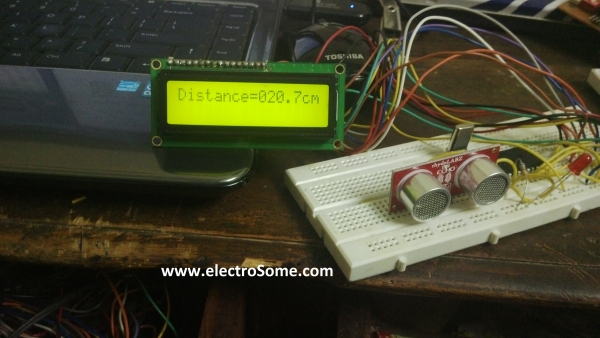 Here for demonstration we are using Rhydolabz Ultrasonic Distance Sensor with ASCII Output. It can be easily interfaced with a PIC Microcontroller using USART by just connecting the output pin of the sensor to RX pin of the microcontroller. In every 500ms this sensor transmits an ultrasonic burst and listens for its echo. The sensor sends out ASCII value corresponds to the time required for the ultrasonic burst to return to the sensor. The UART of the sensor is operates at a baud rate 9600 and the sensor can be powered by a 5V DC Supply. The ASCII output of the sensor will be equal to the distance to the obstacle in centimeter (cm).
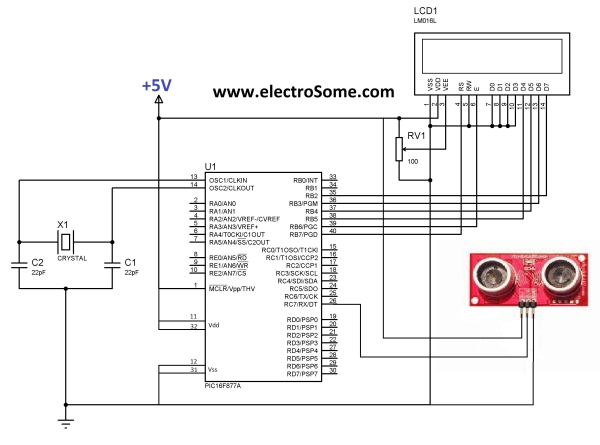 The sensor has three pins…
- Vcc – +5V DC Supply to the Sensor
- GND – Ground Level of the Power Supply
- SIG – Signal, Serial Data Out'
For more detail: Interfacing Ultrasonic Distance Sensor ASCII Output with PIC Microcontroller
Quick Solutions to Questions related to Ultrasonic Distance Sensor Interface Project:
- What is the measurement range of the ultrasonic sensor?
The sensor provides accurate distance measurements from 2cm to 4m. - How does the sensor transmit distance data?
It sends out an ultrasonic burst every 500ms and returns an ASCII value corresponding to the return time. - Can this sensor be used for moving objects?
Yes, ultrasonic sensors can measure distances between both moving and stationary objects. - What is the operating baud rate of the sensor?
The UART of the sensor operates at a baud rate of 9600. - How do you connect the sensor to the PIC Microcontroller?
Connect the output pin of the sensor directly to the RX pin of the microcontroller. - What voltage supply does the sensor require?
The sensor can be powered by a 5V DC supply connected to the Vcc pin. - What unit of measurement does the ASCII output represent?
The ASCII output equals the distance to the obstacle in centimeters. - What are the three pins available on the sensor?
The sensor has Vcc, GND, and SIG (Signal, Serial Data Out) pins.
Related projects
CAN FD Node based on a PIC18 Microcontroller
The introduction sets the stage for an embedded systems project that involves developing a Embedded C CAN FD project using the MCP2517FD...
Communication & InterfacingLAN9662 Gigabit Switch: Optimized for Industrial Ethernet
Introduction It should come as little surprise therefore that one element of what is now more commonly referred to in some circles...
Communication & InterfacingPIC Microcontroller: Fundamentals & Applications for Students
Introduction Microcontrollers are the key components in the embedded systems market. A variety of embedded systems was formed and developed after the...
Communication & Interfacing10BASE-T1S Ethernet: Simplified OEM Design for Auto Devices
Introduction Cars these days are surrounded by technology. They come loaded with all sorts of electronic gadgets and sensors. This project wants...
Communication & InterfacingDesigning a Microcontroller Framework for PC-Based Control of Electrical Appliances
ABSTRACT The preference for personal computers as a platform for designing and implementing control algorithms is growing due to the ease of...
Communication & InterfacingEfficient Multichannel Data Acquisition with USB Connectivity using PIC Microcontroller
1. INTRODUCTION With the rapid advancements in embedded technology, there is a growing demand for a data acquisition system that combines fast...

Ibrar Ayyub
I am an experienced technical writer holding a Master's degree in computer science from BZU Multan, Pakistan University. With a background spanning various industries, particularly in home automation and engineering, I have honed my skills in crafting clear and concise content. Proficient in leveraging infographics and diagrams, I strive to simplify complex concepts for readers. My strength lies in thorough...