
Summary of How to make a ‘Propeller Display’ using PIC microcontroller
Summary: A Propeller Display built by two undergraduates uses persistence of vision with a rotating LED array driven by a PIC16F84A microcontroller to create steady visual patterns as the LEDs flash at precise positions while spinning.
Parts used in the Propeller Display:
- Microchip PIC16F84A
- 10K ohm resistor (5)
- 120 ohm resistor (7)
- 4 MHz crystal oscillator
- 220 µF capacitor
- 3 mm yellow LED (7)
- On/Off Control switch
- DC motor
- 9V battery (for circuit power, converted to 5V)
- 12V variable power supply (for DC motor)
- ICSP programmer
This is my first post Related to Projects and today i will describe ‘Propeller Display’ project. Me and my friend Rushi, we both made ‘Propeller Display’ project during our under-graduation. Below is the photo of the project.
Project uses Microchip PIC16F84A Microcontroller. Below is the brief specification for same.
- 18-Pin, 8-bit microcontroller
- Operating Speed – 20MHz max.
- 1024 words of program memory (word length – 14 bits)
- 68 bytes of Data RAM

- 68 bytes of Data EEPROM
- 14-bit wide instruction words
- 8-bit wide data bytes
- 15 special purpose registers
- Four interrupt sources: Ext. RB0/INT pin, TMR0 overflow, PORTB<7:4> interrupt-on-change, Data EEPROM write complete
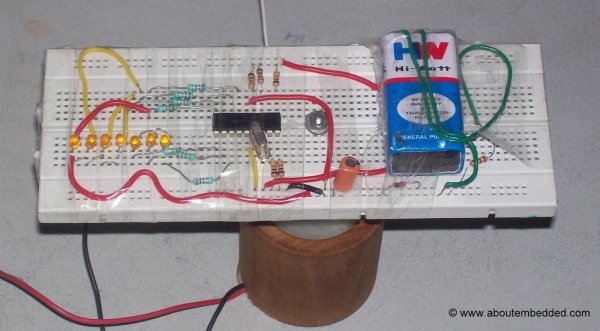
The principle of this project is perception of Vision(POV). Quating from Wikipedia,
“Persistence of vision is the phenomenon of the eye by which an afterimage is thought to persist for approximately one twenty-fifth of a second on the retina.”
From the definition we can understand that our retina retains the view of past image for approximately 1/125 sec = 0.008 sec. Lets, consider a example of torch, if one project the light-spot on wall, further he moves the light-spot circle back and forth horizontally and gradually increases the speed. Then at a time, eye of viewer can not differentiate the light-spot circle and it is viewed as one straight horizontal line of light instead of circle.Same idea applies here. In propeller display, continuous projection of LED’s patterns (Some LEDs are ON and others are OFF) at specific location with rotating entity, gives visual appearance as steady patterns.
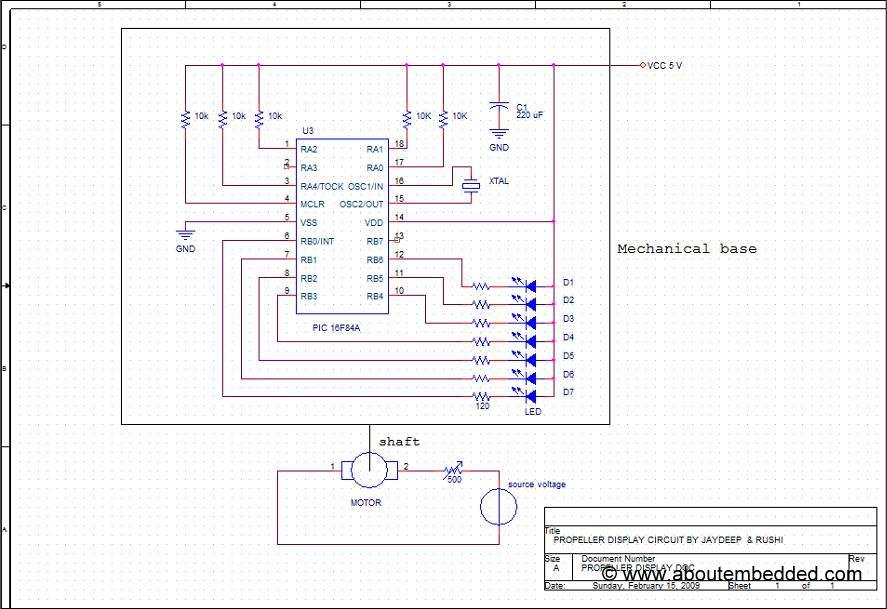
Below is the Schematic of project. We have used Jon stanley’s propeller clock as Reference design.
Components:-
| Microchip PIC16F84A | 1 |
| 10K ohm resister | 5 |
| 120 ohm resister | 7 |
| 4 MHz crystal oscillator | 1 |
| 220 µF capacitor | 1 |
| 3 mm yellow LED | 7 |
| On/Off Control switch | 1 |
| DC motor | 1 |
Requirements:-
- 9V battery to power circuit on breadboard (which will be converted into 5V)
- 12V volt variable power supply for DC motor
- ICSP programmer
For more detail: How to make a ‘Propeller Display’ using PIC microcontroller
- What microcontroller is used in the Propeller Display?
The project uses the Microchip PIC16F84A microcontroller. - How does the Propeller Display create steady visual patterns?
It uses persistence of vision by continuously projecting LED patterns at specific locations while a rotating entity moves the LEDs. - What is the operating speed of the PIC16F84A used?
The PIC16F84A has a maximum operating speed of 20 MHz. - How many LEDs are used in the project?
The project uses seven 3 mm yellow LEDs. - What power sources are required for the project?
A 9V battery (converted to 5V) to power the circuit and a 12V variable power supply for the DC motor are required. - Is an ICSP programmer required?
Yes, an ICSP programmer is required. - What reference design was used for the schematic?
Jon Stanley's propeller clock was used as the reference design. - How much program memory does the PIC16F84A have?
It has 1024 words of program memory with 14-bit word length. - What interrupts sources does the PIC16F84A provide?
It provides four interrupt sources: external RB0/INT pin, TMR0 overflow, PORTB interrupt-on-change, and Data EEPROM write complete.
