
Summary of FUEL GAUGES OFFER HIGHEST LEVEL OF BATTERY PROTECTION
The article introduces Maxim's MAX17301 and MAX17311, 1-cell battery fuel gauges featuring low quiescent current (24μA/18μA) and patented ModelGauge m5 EZ for high SOC accuracy without characterization. These devices offer configurable voltage/current thresholds across temperature zones, SHA-256 authentication against counterfeits, and a unique secondary protection scheme that disables the battery via fuse or protector override during severe faults.
Parts used in the Battery Fuel Gauge Project:
- MAX17301 device
- MAX17311 device
- ModelGauge m5 EZ algorithm
- SHA-256 authentication module
- Secondary protector
- Fuse
- FETs
Fuel Gauges Combine Monitoring With Battery Protection
Maxim’s MAX17301 and MAX17311 are single-cell battery fuel gauges designed to do more than estimate remaining charge. They combine state-of-charge monitoring with configurable voltage, current, and temperature-based protection functions, helping designers manage both battery performance and fault conditions within the same device family.
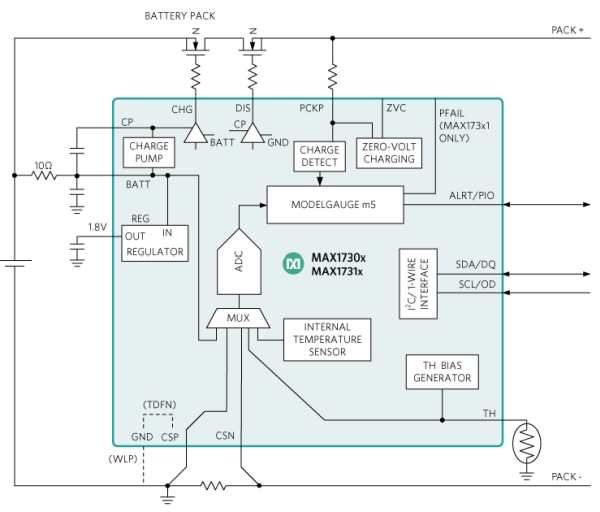
Temperature-Based Thresholds Allow More Precise Protection
The devices allow voltage and current protection thresholds to be adjusted according to different temperature zones. This matters because safe charging and discharging limits can change as a lithium-ion cell becomes hotter or colder. Configurable thresholds let designers align protection behavior more closely with the requirements of the selected battery rather than relying on one fixed limit under every condition.
Secondary Protection Adds Another Safety Layer
The MAX17301 and MAX17311 include a second level of protection intended to act if the primary protection mechanism fails. Under severe fault conditions, the secondary system can permanently disable the battery by controlling an additional protector or blowing a fuse. This type of backup protection is intended for situations where continuing operation could create an unacceptable battery safety risk.
State-of-Charge Data Can Improve Cutoff Decisions
Traditional battery protectors typically monitor parameters such as voltage and current, but they may not consider the battery’s estimated state of charge when making protection decisions. Integrating fuel-gauge information with protection logic gives the system more context about the cell’s condition and may help reduce unexpected shutdown behavior caused by simplistic undervoltage thresholds.
ModelGauge m5 EZ Estimates Remaining Battery Capacity
The devices use Maxim’s ModelGauge m5 EZ algorithm to estimate battery state of charge. According to Maxim, the algorithm is designed to provide accurate gauging without requiring the detailed battery-characterization process associated with some traditional fuel-gauge implementations. This can reduce development effort, although designers should still validate gauging performance with the actual cell, load profile, and operating conditions used in their product.
Low Quiescent Current Supports Battery-Powered Devices
The family is specified for approximately 24µA quiescent current with the protection FETs enabled and 18µA in hibernate mode. Low standby consumption is important in devices that spend significant periods idle because the monitoring circuitry itself should not consume a large portion of the available battery capacity.
Authentication Helps Identify Approved Batteries
SHA-256 authentication allows a host system to verify compatible battery packs using cryptographic credentials. This capability can help manufacturers distinguish approved batteries from unauthorized replacements or cloned packs. Authentication does not prove that every authenticated battery is physically healthy, but it can become one part of a broader battery-management and product-security strategy.
Protection Covers Multiple Battery Fault Conditions
The devices are intended to protect against conditions including overvoltage, excessive current, short circuits, and operation outside configured temperature limits. Combining several monitoring functions in one IC can simplify battery-pack design compared with implementing every protection mechanism using separate components.
Configurability Helps Match Different Cell Requirements
Battery cells can differ in voltage limits, temperature characteristics, discharge capability, and charging requirements. The configurable architecture of the MAX17301 and MAX17311 allows designers to tune protection settings to the battery and product rather than treating all single-cell lithium-ion systems identically. These values should be based on cell manufacturer specifications and validated during product testing.
Fuel Gauging Supports Longer Runtime Without Ignoring Safety
Portable-product designers often want to use as much of a cell’s available capacity as possible, but extending runtime should not come at the expense of battery protection. Combining state-of-charge estimation with configurable safety thresholds can help designers balance usable energy with operating limits defined for the cell.
Devices Support Safety-Oriented Battery Designs
The MAX17301 and MAX17311 were positioned to help designers implement two-level lithium-ion protection and support safety-oriented product development, including systems targeting standards such as IEC 62368-1 and UL 62368-1. Meeting a safety standard, however, depends on the complete product design and certification process rather than on selecting a single compliant component.
MAX17301 and MAX17311 Integrate Several Battery Functions
The main advantage of these Maxim fuel gauges is the combination of charge estimation, configurable protection, low-power monitoring, secondary fault protection, and SHA-256 authentication in a single-cell battery solution. For practical deployment, designers still need to select protection thresholds carefully, follow the battery manufacturer’s limits, validate fuel-gauge accuracy, and test fault behavior within the finished system.
Read more: FUEL GAUGES OFFER HIGHEST LEVEL OF BATTERY PROTECTION
-
What is the quiescent current of these devices?
The devices have a quiescent current of 24μA with FETs enabled and 18µA in hibernate mode. -
How do these devices protect against counterfeit batteries?
They include SHA-256 authentication to safeguard systems from counterfeit and cloning attempts. -
Does the ModelGauge m5 EZ require battery characterization?
No, the patented algorithm delivers highest state-of-charge accuracy that eliminates the need for battery characterization. -
What happens if the primary protection fails?
A secondary protection scheme permanently disables the battery by overriding a secondary protector or blowing a fuse. -
Can voltage and current thresholds be tuned based on temperature?
Yes, the configurable settings allow fine tuning of voltage and current thresholds based on various temperature zones. -
Why are conventional battery protectors considered vulnerable?
They are vulnerable because they do not factor in battery state-of-charge when triggering undervoltage cut-off decisions. -
How much lower is the quiescent current compared to competitors?
The quiescent current is up to 80 percent lower than the nearest competitor.
