
Summary of FOR HIGHER POWER DENSITY AND REDUCED BOM: MELEXIS MLX91220/21 CURRENT SENSORS AT RUTRONIK
Melexis’ MLX91220 and MLX91221 are isolated integrated Hall-effect current sensors for AC and DC measurements (0–50 A) with analog outputs, low conductor resistance, 300 kHz bandwidth, and dual on-chip overcurrent detection outputs. They minimize thermal losses and BoM by combining low ohmic loss integrated conductors, fast internal/external OCD (2 μs/10 μs), no ferromagnetic concentrators, and suitability for automotive and industrial power-conversion applications.
Parts used in theMLX91220/21 Current Sensor Project:
- MLX91220 integrated Hall-effect current sensor
- MLX91221 integrated Hall-effect current sensor
- SOIC8 package with 0.9 mΩ integrated conductor
- SOIC16 package with 0.75 mΩ integrated conductor
- Dual on-chip overcurrent detection circuitry
- Analog output interface
- Isolation barrier for primary-to-secondary separation
- Integrated primary conductor
Minimize thermal losses: With the MLX91220 and MLX91221, Melexis presents two integrated current sensors for AC and DC measurements with an analog interface. These are isolated integrated Hall-effect current sensors with 0-50A and dual OCD (overcurrent detection). This all-in-one solution offers an optimal symbiosis of small size, low impedance, high bandwidth and isolation.
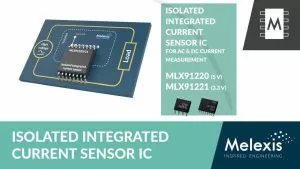
Dual on-chip overcurrent detection with a separate output also reduces the BoM by eliminating the need for external protections against OC. The sensors are suitable for use in automotive and industrial applications (e.g. OBC), D/DC converters and small electric drives as well as power supplies. Their 300kHz bandwidth predestines them for use in power conversion at less than 50Aeff.
Low power Dissipation
The sensors impress with the particularly low ohmic losses of the integrated conductor (0.9mΩ for SOIC8 and 0.75mΩ SOIC16). Shielding against stray fields with regard to the differential measuring principle is thus not necessary. The combination of internal and external monitoring mechanism ensures optimization of dual on-chip overcurrent detection. The response time of the internal OCD threshold is just 2μs, that of the external 10μs.
No magnetic hysteresis
A special sensor concept captures the magnetic field generated by the integrated primary conductor, eliminating the need for ferromagnetic concentrators. This enables higher density power electronics.
Read more: FOR HIGHER POWER DENSITY AND REDUCED BOM: MELEXIS MLX91220/21 CURRENT SENSORS AT RUTRONIK
- What current range do the MLX91220 and MLX91221 support?
They support 0–50 A measurements as stated in the article. - Can these sensors measure both AC and DC currents?
Yes, the article states they are for AC and DC measurements. - Do the sensors provide overcurrent detection?
Yes, they include dual on-chip overcurrent detection with a separate output. - What are the OCD response times for internal and external thresholds?
The internal OCD threshold response time is 2 μs and the external is 10 μs. - Are ferromagnetic concentrators required?
No, the sensor concept eliminates the need for ferromagnetic concentrators, so none are required. - What bandwidth do the sensors offer?
The sensors have a 300 kHz bandwidth suitable for power conversion below 50 Aeff. - What are the conductor resistances for the package options?
The SOIC8 integrated conductor has 0.9 mΩ and the SOIC16 has 0.75 mΩ. - Do these sensors reduce BoM for applications?
Yes, the dual on-chip OCD with a separate output reduces the BoM by eliminating the need for external OC protections. - Which applications are these sensors suited for?
They are suitable for automotive and industrial applications such as OBC, D/DC converters, small electric drives, and power supplies.