
Summary of Fastest 18-Bit SAR ADC unveiled
The AD7960 is an industry-leading 18-bit, 5 MSPS SAR ADC designed for low-power applications like digital X-rays and MRI. It features a high-speed sampling mechanism with differential inputs, internal clocking, and an LVDS serial interface. Its architecture delivers exceptional noise performance (99 dB SNR) and linearity while consuming only 39 mW, making it ideal for spectroscopy and data acquisition systems.
Parts used in the AD7960 Project:
- AD7960 18-bit SAR ADC
- Internal conversion clock
- Internal reference buffer
- External reference voltage source
- LVDS self-clocked or echo-clocked serial interface
- 32-lead LFCSP (QFN) package
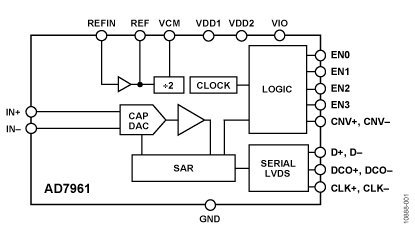
The AD7960 is an 18-bit, 5 MSPS charge redistribution successive approximation (SAR), analog-to-digital converter (ADC). The SAR architecture allows unmatched performance both in noise and in linearity. The AD7960 contains a low power, high speed, 18-bit sampling ADC, an internal conversion clock and an internal reference buffer. On the CNV± edge, the AD7960 samples the voltage difference between the IN+ and IN− pins. The voltages on these pins swing in opposite phase between 0 V and 4.096 V/5 V. The reference voltage is applied to the part externally. All conversion results are available on a single LVDS self-clocked or echo-clocked serial interface.
The AD7960 is available in a 32-lead LFCSP (QFN) with operation specified from −40°C to +85°C.
APPLICATIONS
- Digital imaging systems
Digital X-rays
Computed tomography
IR cameras - MRI gradient control
- High speed data acquisition
- Spectroscopy
- Test equipment
FEATURES and BENEFITS
- Throughput: 5 MSPS
- 18-bit resolution with no missing codes
- SNR 99 dB
- INL +/-0.8 LSB
- DNL +/-0.5 LSB
- True differential analog input voltage range: ±4.096 V or ±5 V
- Low power dissipation (39 mW)
- SAR architecture
- External reference options
- Serial LVDS interface
- 32-lead, 5mm × 5mm LFCSP (QFN)
- See datasheet for more details
Analog Devices is claiming a first, with an 18bit successive approximation (SAR) ADC that can hit 5Msample/s – said to be twice as fast as anyone else’s.
“With its industry leading throughput, best-in-class noise floor and high linearity, the AD7960 was designed for low-power signal chains, multiplexed systems such as digital X-ray, and oversampling applications including spectroscopy, MRI gradient control and gas chromatography,” said the firm.
The figures are:
- 22.4nV/√Hz noise floor relative to its full scale input
- +/-0.8 LSB INL dc linearity
- 99dB signal to noise ratio.
- 39mW consumption at 5Msample/s.
– See more at: http://www.electronicsweekly.com/news/components/analogue-and-discretes/fastest-18-bit-sar-adc-unveiled-2013-09/#sthash.VhuCfEEJ.dpuf
-
What is the maximum throughput of the AD7960?
The AD7960 offers a throughput of 5 MSPS. -
How much power does the AD7960 consume at full speed?
The device consumes 39 mW when operating at 5 Msample/s. -
Does the AD7960 have missing codes?
No, the AD7960 provides 18-bit resolution with no missing codes. -
What type of analog input does the AD7960 support?
It supports a true differential analog input voltage range of ±4.096 V or ±5 V. -
Can the AD7960 be used for MRI gradient control?
Yes, the AD7960 is designed for applications including MRI gradient control. -
What is the signal-to-noise ratio of the AD7960?
The AD7960 achieves a signal-to-noise ratio of 99 dB. -
How many leads does the AD7960 package have?
The AD7960 is available in a 32-lead LFCSP package. -
Is the reference voltage applied internally or externally?
The reference voltage is applied to the part externally.
