
Summary of Easy Pulse mikro – A mikroBus compatible pulse sensor
Easy Pulse mikro is a mikroBus-compatible add-on board that detects cardiovascular pulse signals from a fingertip using infrared transmittance photoplethysmography. It outputs a clean analog PPG waveform to the AN pin and includes an onboard LED for visual heartbeat indication.
Parts used in the Easy Pulse mikro:
- Easy Pulse mikro sensor board
- mikroBus socket connector
- Infrared sensors
- Amplification circuitry
- Filtering components
- Onboard potentiometer
- Indicating LED
- Audio jack connector
Easy Pulse mikro is a new addition to our Easy Pulse Sensor series. The word mikro signifies that it’s an add-on board in mikroBus form factor, which enables easy integration with mikroElektronika‘s numerous development boards. Similar to our original Easy Pulse V1.1 and Easy Pulse Plugin, it also operates on the principle of transmittance photoplethysmography applied to a fingertip using infrared sensors. Easy Pulse mikro provides all necessary instrumentation and amplification on board to detect the cardiovascular pulse signal from the fingertip. The output is a nice and clean analog PPG waveform that is routed to the AN pin of the mikroBus connector. Currently, you can buy this sensor from our Elecrow Store.
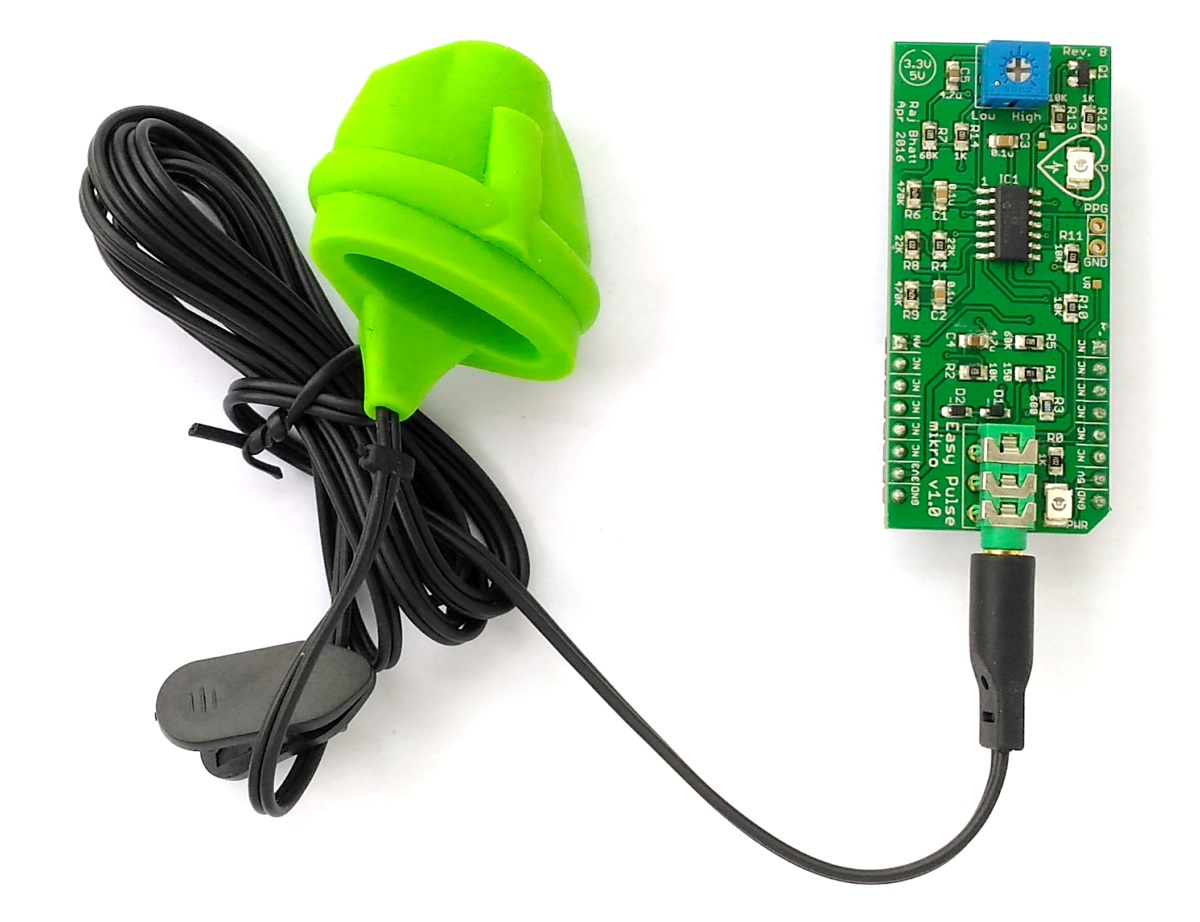
Features
- Compatible with mikroBus socket.
- Filtered and amplified analog PPG signal output (range: 0-3.3V).
- On board potentiometer for adjusting amplifier gain, if needed (rotate clock-wise for increasing the gain).
- On board LED for indicating the heart beat. It flashes synchronously with the heart beat on detecting the pulse from fingertip.
The following figure shows an actual PPG output waveform from Easy Pulse mikro. The pulse rate (or heart beat rate) can be computed from the time duration between any two peaks in the signal. This is described in more detail in a demo application provided later in this article.
Important note: While operating the pulse sensor, make sure the sensor connector is inserted well and pushed all the way into the audio jack as shown below. During operation, the hand must be in a relaxed position and resting on some solid support for achieving reliable PPG data.
For More Details : Easy Pulse mikro – A mikroBus compatible pulse sensor
- What principle does Easy Pulse mikro use?
It operates on the principle of transmittance photoplethysmography applied to a fingertip using infrared sensors. - How is the output signal routed?
The clean analog PPG waveform is routed to the AN pin of the mikroBus connector. - Can I adjust the amplifier gain?
Yes, you can use the onboard potentiometer by rotating it clockwise to increase the gain. - Does the device have a visual indicator?
An onboard LED flashes synchronously with the heart beat when detecting a pulse. - How do I compute the pulse rate?
The pulse rate is computed from the time duration between any two peaks in the signal. - What is the output voltage range?
The filtered and amplified analog PPG signal output ranges from 0 to 3.3V. - How should I position my hand during operation?
The hand must be in a relaxed position and resting on some solid support for reliable data. - How do I ensure proper connection?
The sensor connector must be inserted well and pushed all the way into the audio jack.