
Summary of F1200 Low-noise Digital IF VGA with FlatNoise
The IDT F1200 is a digitally controlled differential variable gain amplifier designed for intermediate frequency applications up to 300MHz. It features low noise figures, exceptional linearity (DNL/INL), and minimal distortion, allowing direct ADC driving in sub-sampling scenarios. By maintaining constant output IP3 while adjusting gain, it enhances system SNR by up to 2dB at low settings. The device supports dynamic or one-time gain adjustments and fits into compact 5x5 Thin QFN packages with 200-ohm impedances, suitable for transmitters, receivers, base stations, and public safety systems.
Parts used in the F1200 Project:
- IDT F1200 digitally controlled intermediate frequency differential variable gain amplifier
- Compact 5x5 Thin QFN package
- ADC (Analog-to-Digital Converter) for direct IF sub-sampling application
The F1200 of an IDT is a digitally controlled intermediate frequency differential variable gain amplifier that adjusts the gain either dynamically or as a one-time channel gain setting. The device has extremely low noise figure over the entire gain control range. It is packaged in compact 5×5 Thin QFNs with 200 ohm differential input and output impedances for ease of integration into the receiver lineup with IF frequencies up to 300MHz.
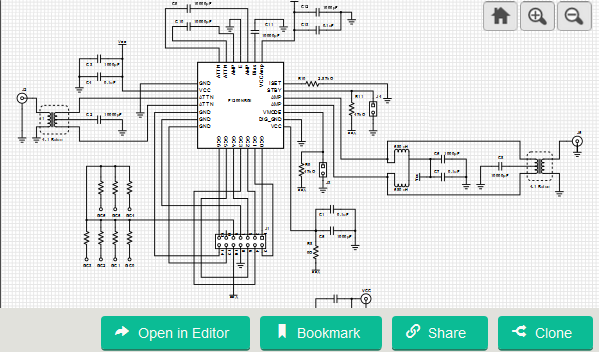 The device has exceptional DNL and INL simplifying digital compensation. It has extremely low Harmonic, IM2, and IM3 distortion that is necessary to drive an ADC directly in an IF sub-sampling application. The F1200 acts to enhance system SNR when VGA gain is reduced. The F1200 noise figure (NF) degrades only slightly (NF slope ~ -0.16 dB/dB) over a 13 dB control range while holding the output IP3 approximately constant. The resultant improvement in noise can enhance the system SNR up to 2 decibels at low gain settings relative to a standard VGA.
This design is used in either transmitter or receiver to add an adjustable gain element to the signal chain by increasing or decreasing the attenuation value. Other applications include base station, diversity receivers, digital pre-distortion, μ–wave point-to-point radios and public safety receivers.
For more detail: F1200 Low-noise Digital IF VGA with FlatNoise
- How does the F1200 adjust its gain?
The device adjusts gain either dynamically or as a one-time channel gain setting. - What is the maximum IF frequency supported by the F1200?
The device supports IF frequencies up to 300MHz. - Does the F1200 degrade significantly when gain is reduced?
No, the noise figure degrades only slightly with an NF slope of approximately -0.16 dB/dB over a 13 dB control range. - Can the F1200 drive an ADC directly?
Yes, its extremely low Harmonic, IM2, and IM3 distortion makes it necessary to drive an ADC directly in an IF sub-sampling application. - What packaging type does the F1200 use?
The device is packaged in compact 5x5 Thin QFNs. - How much can the F1200 enhance system SNR at low gain settings?
The resultant improvement in noise can enhance the system SNR up to 2 decibels relative to a standard VGA. - What are some specific applications for this design?
Applications include base station, diversity receivers, digital pre-distortion, μ-wave point-to-point radios, and public safety receivers. - Does the F1200 maintain constant output IP3 during gain changes?
Yes, it holds the output IP3 approximately constant while the gain varies.