


Summary of El Cheapo, the cheap way to program a PIC microcontroller
This article compares commercial PIC programmers with a DIY option called "El Cheapo." While starter kits like the Microchip PIC32 offer USB connectivity and cost around $50, El Cheapo provides a budget-friendly alternative under $10. However, it requires an obsolete LP-25 printer port on the computer, which may limit its usability for modern systems without adapters.Parts used in the El Cheapo Project:
- Microcontroller components
- Programming interface hardware
- LP-25 printer port connector
If you ever wanted to do a project involving microcontrollers, the first thing you need is a microcontroller, and programmer. Many commercial PIC programmers exist. These programmers cost anywhere from 25 to 250 dollars depending on how many different PICs are supported and how greedy the manufacturer is. 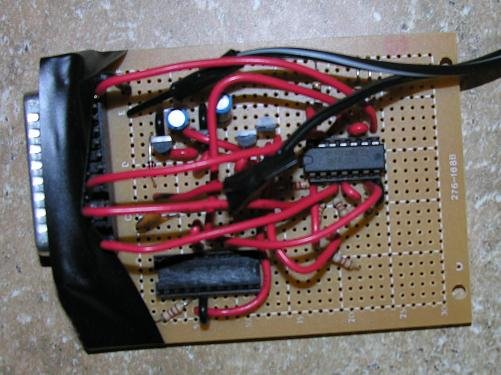 In my other article, I gave a great review for the Microchip PIC32 starter kit, which includes the chip, programmer, and debugger. Best of all, it connects to your computer via a USB port, which is excellent since all modern computer have USB. The PIC32 starter kit only costs 50 dollars, which is more than reasonable.
However, there is a cheaper alternative if you are truly trying to save money on your hobby project. The cheapest way to get a PIC programmer is to make one yourself! The design is called El Cheapo, mainly because all the components together cost less than 10 dollars. Luckily, El Cheapo is extremely easy to make. Schematics of the programmer may be found by their original creator here.
What does this programmer look like? Here are some pictures I’ve taken of my El Cheapo programmer which I built.
Unfortunately, the El Cheapo programmer connects to your computer via an LP-25 printer port, which many computers do not have because it is now obsolete. If you’re thinking about building a PIC programmer yourself, be sure that you have a printer port on your computer. Otherwise, it’s best just to get a starter kit from Microchip which has a USB connection.
For more detail: El Cheapo, the cheap way to program a PIC microcontroller
- How much does the El Cheapo programmer cost?
All components together cost less than 10 dollars. - Does the El Cheapo programmer use a USB connection?
No, it connects via an LP-25 printer port. - Can I build the El Cheapo programmer easily?
Yes, the design is described as extremely easy to make. - What is the main advantage of the Microchip PIC32 starter kit?
It includes a chip, programmer, debugger, and connects via USB. - Is the Microchip PIC32 starter kit expensive?
No, it costs 50 dollars, which is considered reasonable. - What should I check before building the El Cheapo programmer?
You must ensure your computer has an LP-25 printer port. - Where can I find the schematics for the El Cheapo programmer?
Schematics are available from the original creator online. - Why might someone choose the PIC32 starter kit over El Cheapo?
Modern computers often lack printer ports, making USB connections preferable.
Related projects
Calculator Test using PIC24FJ64GA006 with Proteus Simulation
Introduction The Calculator Test using EASYHDL is a practical microcontroller project built on the PIC24FJ64GA006 and simulated in Proteus. This project demonstrates...
Programmers & ICSPPID Controlled Oven using TMS320F28027PT with Proteus Simulation
IntroductionThis project demonstrates a PID controlled oven implemented using a PICCOLO TMS320F28027PT microcontroller and verified through Proteus simulation.It is a practical microcontroller...
Programmers & ICSPPICCOLO Motor Controller Sample Design using TMS320F28023PT with Proteus Simulation
IntroductionThis project demonstrates a PICCOLO motor controller sample design implemented using the TMS320F28023PT Piccolo microcontroller and tested through Proteus simulation. It focuses...
Programmers & ICSP · PIC16F84APIC Musical Doorbell using PIC16F84A with Proteus Simulation
IntroductionThis microcontroller project demonstrates a musical doorbell built around a PIC16F84A and a simple piezo sounder.Using two push buttons, the system allows...
Programmers & ICSP · PIC16F877AEPE PIC/LCD Demo using PIC16F877 with Proteus Simulation
IntroductionThe EPE PIC/LCD Demo is a classic microcontroller project that demonstrates how a PIC16F877 can fully control a PG12864F graphical LCD.Designed as...
Programmers & ICSP · PIC16F628ADHT11 Low Cost Humidity Sensor using PIC16F628A with Proteus Simulation
IntroductionThis microcontroller project demonstrates how to interface a low-cost DHT11 temperature and humidity sensor with a PIC16F628A using a Proteus simulation environment.The...

Ibrar Ayyub
I am an experienced technical writer holding a Master's degree in computer science from BZU Multan, Pakistan University. With a background spanning various industries, particularly in home automation and engineering, I have honed my skills in crafting clear and concise content. Proficient in leveraging infographics and diagrams, I strive to simplify complex concepts for readers. My strength lies in thorough...