


'Caller Line Identification' displays on a (2x16) LCD the phone number of the person who is ringing you, before you even answer.
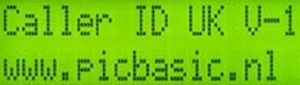
When start up the first few seconds appears the version number in the display.
Direct after programming the PIC stays in TEST-mode.
You can recognize this on the word TEST which appears continue on the right on the second line in the LCD.
(Disabling this see text)
After power up, appears the number of stored telephone numbers and burns the 'new numbers' LED, if it was also on before the power failure.
If there are no new numbers stored when power up, then the LED stays off and is this reported also on the second line from the display.
If there are no numbers at all then appears 'No numbers' on the display.
'Caller Line Identification' displays on a (2x16) LCD the phone number of the person who is ringing you, before you even answer, this number stays on the LCD till it wil replaced by a new received phone number OR if the button is pressed.
With the button you can 'leaf' trough the phone numbers.
The second line displays how many phone numbers are stored in memory.
A (a)new received phone number is marked in the display with *N*, it disappears when it's number has been seen.
Max.12 10-numerals telephone numbers can stored in PIC's EEPROM.
When the memory is full, a message is displayed and the backlight and LED blinks slow.
There still can appear new numbers on the display, but these numbers are not stored in memory anymore.
When the button is pressed longer then 2 seconds, the LCD reports the question to erase all stored phone numbers.
For admitting push the button again, when waiting longer then 2 seconds the CLI goes back to the original screen (no erasing).
(However, when a (new) received number is not seen yet, erasing is not possible.)
The memory is empty again.
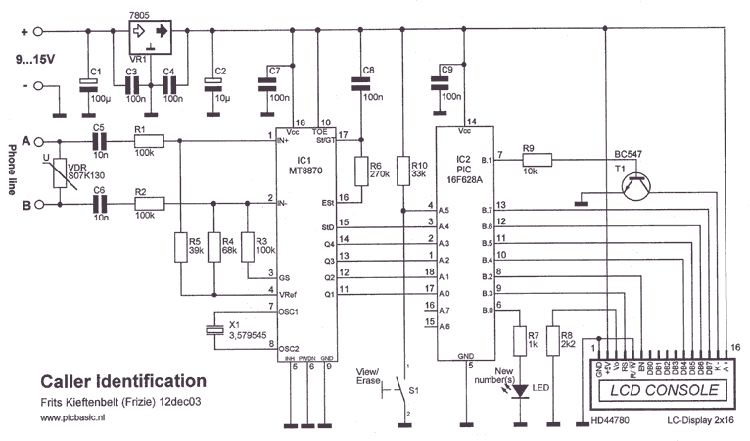
You can also enable TEST-mode when you press the button while you switch the power on.
The LED burns when new number(s) are received and goes off when all the new numbers has been watched.
This LED blinks fast for a while when a received number is already stored in memory.
By a phone call or a push on the button the backlight from the LCD burns for about 30 seconds.
For more detail: Caller Line Identification (CLI) using PIC16F628A
Related projects
DHT11 Low Cost Humidity Sensor using PIC16F628A with Proteus Simulation
IntroductionThis microcontroller project demonstrates how to interface a low-cost DHT11 temperature and humidity sensor with a PIC16F628A using a Proteus simulation environment.The...
LCD & Display Projects · PIC16F628AFrequency Counter by PIC16F628
In this project we are building a basic and low cost frequency counter circuit . It can measure from 16Hz to 100Hz...
Games, Toys & Calculators · PIC16F628ATIC TAC TOE game using PIC16F628
This project is not to introduce Tic Tac Toe. Everyone knows this game. It's to introduce two features. Bi-coloured LEDs, microcontrollers and...
Wireless & IoTExploring Various Applications of Microcontrollers: A World of Tiny Brains
Exploring Various Applications of Micro Controller Microcontrollers have become ubiquitous in the modern world with applications in nearly every industry. This student...
Wireless & IoTIntelligent Sips: Revolutionizing Dining with the SmartCup
Abstract The SmartCup Attachment is a comprehensive system designed for restaurants to monitor the liquid levels in their customers' cups. This system...
Wireless & IoTMaximizing Wi-Fi Capabilities with the Explorer 16 Development Board
As society progresses, the necessity for wireless communication is evolving from a mere luxury to an essential requirement. Wi-Fi, extending beyond conventional...

Ibrar Ayyub
I am an experienced technical writer holding a Master's degree in computer science from BZU Multan, Pakistan University. With a background spanning various industries, particularly in home automation and engineering, I have honed my skills in crafting clear and concise content. Proficient in leveraging infographics and diagrams, I strive to simplify complex concepts for readers. My strength lies in thorough...