
Summary of ANALOG DEVICES LAUNCHED TWO ETHERNET CHIPS FOR UP TO 1.7KM DISTANCE COMMUNICATION
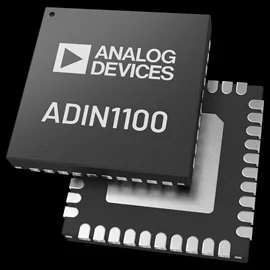
Analog Devices released two IEEE 802.3cg-2019–compliant 10BASE-T1L Ethernet chips (ADIN1100 PHY and ADIN1110 MAC-PHY) enabling single twisted-pair Ethernet over distances up to about 1.7 km for long-range industrial and noisy environments. The ADIN1100 is a low-power, single-port transceiver integrating PHY core, analog circuitry, clock buffering, management interfaces, MAC interface logic, and supports 1 Vpp operation, independent Rx/Tx pins, and external termination for intrinsic safety.
Parts used in the10BASE-T1L Ethernet Chips Project:
- ADIN1100 Ethernet PHY chip
- ADIN1110 Ethernet MAC-PHY chip
- Single twisted-pair Ethernet cable (10BASE-T1L)
- External termination resistors
- Clock buffering circuitry
- Management interface and control registers (on-chip)
- MAC interface and control logic (on-chip)
- Analog circuitry for PHY (on-chip)
Ethernet cables are commonly applicable in local area networks (LANs) and wide-area networks (WANs). The ethernet cables support higher bit-rates and longer link distance than other wired LAN technologies such as ARCNET and Token Ring. Ethernet cables are practical when wiring your house. But if you want to connect corporate campuses with them, fiber optics are a better choice to get around the limits of Ethernet cable. There are a few different versions of ethernet cable, but they all have a maximum distance of 90-100 meters. This limit is because the faster we push data, the more sensitive the data becomes to degradation. With lower bit rates up to 100 Mbps or 10 Mbps, we can get a much longer cable. Ethernet cables with a bandwidth of 100 Mbps are tested to go further at 400+ feet with no errors.
A new ethernet physical layer standard (IEEE 802.3cg-2019) was approved by the IEEE on November 7, 2019, to allow for cables over one kilometer using a single twisted-pair cable. These new variants of ethernet cables support ten megabits per second Ethernet over a single twisted pair. The 10BASE-T1L ethernet standard is preferred for long-range industrial IoT applications as well as short-distance applications where substantial electrical noise is present.
Analog Devices has launched two 10BASE-T1L Ethernet chips with ADIN1100 Ethernet PHY and ADIN1110 Ethernet MAC-PHY. The chips are compliant with the IEEE 802.3cg Ethernet standard. The ADIN1100 is a robust low-power single port 10BASE-T1L transceiver designed for long-range industrial applications.
It integrates an Ethernet PHY core with all the associated analog circuitry, input and output clock buffering, the management interfaces control register and subsystem registers, and the MAC interface and control logic to manage the reset and clock control and pin configuration. The chip has 1V peak to peak operation mode, independent Rx/Tx pins, external termination resistors for intrinsic safety applications.
Read more: ANALOG DEVICES LAUNCHED TWO ETHERNET CHIPS FOR UP TO 1.7KM DISTANCE COMMUNICATION
- What distances can 10BASE-T1L support?
The new standard and chips support cable lengths over one kilometer and Analog Devices chips enable up to about 1.7 km distance. - Can 10BASE-T1L run over a single twisted pair?
Yes, 10BASE-T1L provides ten megabits per second Ethernet over a single twisted pair. - Which Analog Devices chips implement 10BASE-T1L?
Analog Devices launched ADIN1100 (Ethernet PHY) and ADIN1110 (Ethernet MAC-PHY) compliant with IEEE 802.3cg. - Is 10BASE-T1L suitable for industrial IoT applications?
Yes, 10BASE-T1L is preferred for long-range industrial IoT applications and noisy short-distance environments. - What integrated features does the ADIN1100 include?
ADIN1100 integrates an Ethernet PHY core, analog circuitry, clock buffering, management interfaces and control registers, and MAC interface and control logic. - Does the ADIN1100 support intrinsic safety requirements?
The ADIN1100 provides external termination resistors for intrinsic safety applications. - What operation voltage mode does the ADIN1100 provide?
The chip has a 1 V peak to peak operation mode. - Are Rx and Tx pins independent on the ADIN1100?
Yes, the ADIN1100 has independent Rx and Tx pins.