
Summary of AI DIGITAL SIGNAGE SYSTEM FEATURES AN APOLLO LAKE SOC, DUAL MYRIAD X VPUS AND TRIPLE HDMI PORTS
The IDS-310AI is an ultra-compact AI-ready digital signage mini-PC by IEI that uses an Intel Celeron J3455 (Apollo Lake) and 2x Intel Movidius Myriad X VPUs on a Mustang-MPCIE-MX2 card to enable low-power edge AI (facial recognition, weather feeds, etc.). It supports OpenVINO, triple HDMI 1.4b outputs (up to 3840x2160@30Hz), 8 GB DDR3L, 128 GB SATADOM, multiple I/O, TPM 2.0 security, and operates across wide temperature and shock/vibration specs for energy-saving AI signage deployments.
Parts used in the IDS-310AI:
- Intel Celeron J3455 quad-core SoC (Apollo Lake)
- Mustang-MPCIE-MX2 mini-PCIe AI accelerator card with 2x Intel Movidius Myriad X VPUs
- 1 x 204-pin DDR3L SO-DIMM (8 GB pre-installed)
- 128 GB SATADOM (SATA disk on module)
- MicroSD card slot
- 3 x HDMI 1.4b ports
- 1 x Microphone input
- 1 x Line out
- 2 x RTL8111H GbE LAN ports
- Optional 802.11ac/BT M.2 module and external antenna
- 3 x USB 3.2 Gen1 ports
- 1 x RS-232/422/485 DB-9 with AFC functionality
- 1 x M.2 2230 A-key slot (PCIe x1 and USB 2.0 support)
- 1 x mini PCIe slot (occupied by Mustang-MPCIE-MX2)
- Power and reset button
- AT/ATX switch
- Power and storage LEDs
- 12V DC power input via screw jack
- TPM 2.0 security module
a digital signage player for displaying photos and text or playing videos or PowerPoint slides but AI was introduced and it became possible to use a digital signage system for advanced techs like facial recognition where it can anonymously capture more personalized information such as gender, age, and even mood, as well as for weather detection where it pulls in local weather feeds and displays them automatically on the screen.
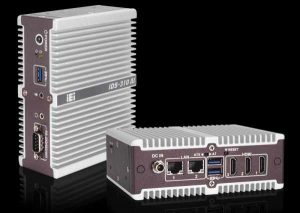
To further expand the impact of AI on this versatile tool, IEI designed an ultra-compact digital signage system called IDS-310AI, optimized for use in energy-saving AI applications.
The IDS-310AI features an Intel Celeron J3455 Apollo Lake processor with 2x Intel Movidius Myriad X VPUs and up to three HDMI ports for image output. The Myriad X VPUs offers “excellent inference performance per watt, 16 SHAVES cores for AI calculations and native FP16 support,” and are deployed via a mini-PCIe module.
The Linux-ready mini-PC also supports Intel’s Open Visual Inference Neural Network Optimization (OpenVINO) which enables convolutional neural network-based, pre-trained models to be used at the edge with little effort. Training models like AlexNet, GoogleNet, Tiny Yolo, Squeezenet, resNet are quick and easy to implement.
Other features include a micro SD card slot, 3x USB 3.2, 2x GbE LAN ports, 1x M.2 A-key slot, pre-installed 8 GB DDR3L SO-DIMM memory, and a 128GB SATA disk on module for storing user data and loading OS.
Specifications:
- SoC: Quad-core, 1.5GHz / 2.3GHz Intel Celeron J3455 processor with 10W TDP
- 1 x 204-pin DDR3L SO-DIMM, 8 GB pre-installed
- 128GB SATADOM for storing user data and loading OS
- 1x MicroSD card slot
- 3x HDMI 1.4b ports with a maximum resolution of 3840 x 2160 pixels at 30Hz each
- 1x Mic in, 1x Line out
- 2x RTL8111H-powered GbE ports
- Optional 802.11ac/BT M.2 module and external antenna
- 3x USB 3.2 Gen1 ports
- 1x RS-232/422/485 DB-9 with AFC functionality
- 1x M.2 2230 A-key slot with support for PCIe x1 and USB 2.0
- 1x mini PCIe slot fitted with Mustang-MPCIE-MX2 (2x Myriad X VPU) AI accelerator card
- Power & reset button
- AT/ATX switch
- Power and storage LEDs
- Power Consumption: 2.6A @ 12V
- Power Supply: 12V DC via screw jack
- Security: TPM 2.0
- Dimensions: 137 mm x 102.8 mm x 49.2 mm
- Weight: 910g
- Operating Temperature Range: -20°C to 45°C
- Humidity: 10% to 95%, non-condensing
- Operating Shock: Half-sine wave shock 5G, 11ms, 100 shocks per axis, IEC68-2-27
- Operating Vibration: MIL-STD-810G 514.6C-1
- Certifications: CE/FCC
- Operating System: Windows 10 or Linux
Read more: AI DIGITAL SIGNAGE SYSTEM FEATURES AN APOLLO LAKE SOC, DUAL MYRIAD X VPUS AND TRIPLE HDMI PORTS
- What processor does the IDS-310AI use?
It uses a quad-core Intel Celeron J3455 Apollo Lake processor with a 10W TDP. - Can the IDS-310AI perform AI inference at the edge?
Yes, it includes 2x Intel Movidius Myriad X VPUs on a Mustang-MPCIE-MX2 card and supports OpenVINO for edge inference. - How many HDMI outputs does the system have?
It has three HDMI 1.4b ports, each supporting up to 3840 x 2160 at 30Hz. - What memory and storage are pre-installed?
It ships with 8 GB DDR3L SO-DIMM pre-installed and a 128 GB SATADOM for OS and user data. - Does the IDS-310AI support wireless connectivity?
Wireless is optional via an 802.11ac/BT M.2 module and external antenna. - Which operating systems are supported?
The system supports Windows 10 or Linux. - What are the environmental operating temperature and humidity ranges?
Operating temperature is -20°C to 45°C and humidity 10% to 95% non-condensing. - What security feature is included?
It includes TPM 2.0 for security. - What I/O options are available for serial communication?
There is an RS-232/422/485 DB-9 port with AFC functionality. - What is the device power supply and consumption?
Power is 12V DC via screw jack, and power consumption is 2.6A at 12V.