


Summary of Rotary Encoder Interfacing with PIC Mirocontroller
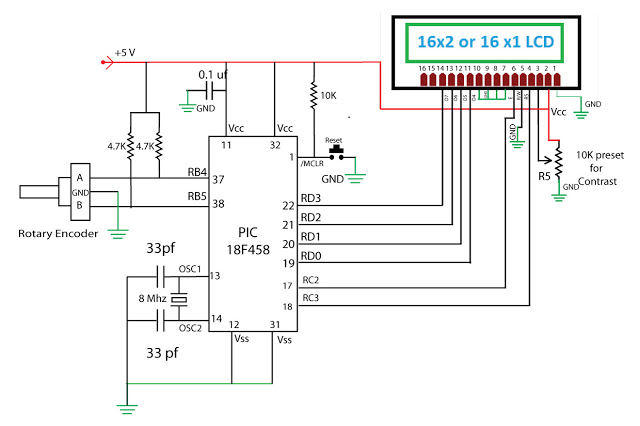
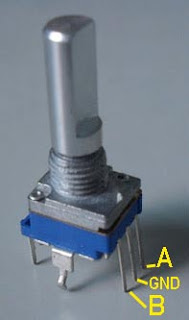
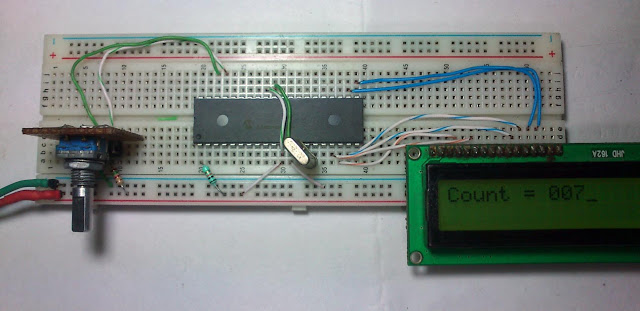
Incremental rotary encoders are digital substitutes for potentiometers, providing pulse outputs that require decoding (often via a microcontroller state machine) to determine rotation direction and steps. The article describes waveform behavior, state-machine decoding, interfacing with a PIC18F458 (schematic), and provides source code/firmware download for implementation.Parts used in the Incremental Rotary Encoder project:
- Incremental rotary encoder
- PIC18F458 microcontroller
- Wiring/connectors
- Power supply for PIC18F458
- Supporting passive components shown in schematic (resistors, capacitors)
- Optional rotary switch or potentiometer for comparison
- Programming/debugging tool for PIC
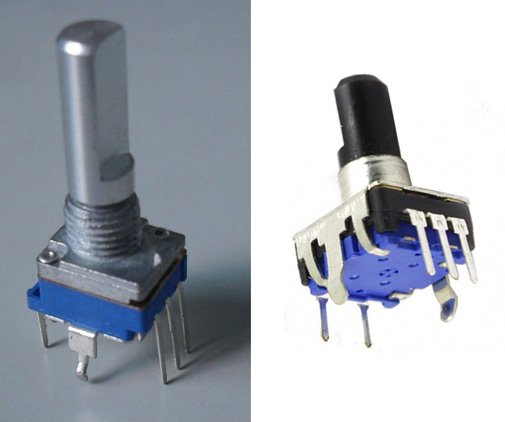
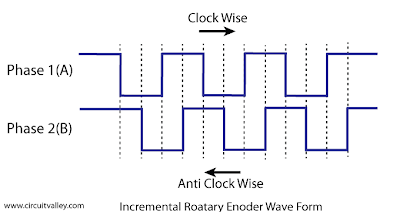
Decoding with Microcontroller
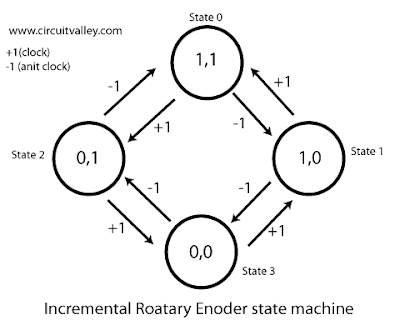
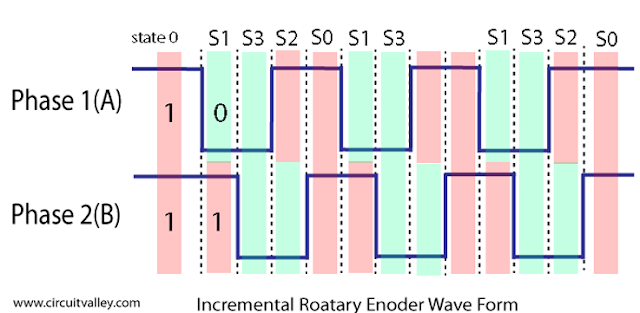
in this examples we will be decoding the rotary encoder with the help of sate machine.
CLIK Here To download Source Code and Firmware. if you have any problem please leave in the comment section.
Quick Solutions to Questions related to Incremental Rotary Encoder:
- What is an incremental rotary encoder?
An incremental rotary encoder is a totally digital component that outputs pulses representing rotational movement, used instead of conventional potentiometers. - Can an incremental rotary encoder directly replace a potentiometer?
No, it cannot be directly replaced because it is a digital component and requires decoding via electronics or a microcontroller. - How are encoder outputs decoded?
Encoder outputs are decoded with a microcontroller using a state machine to determine direction and steps from the waveform. - Does the article provide a schematic for interfacing?
Yes, the article includes a schematic showing interfacing with a PIC18F458 microcontroller. - Is source code or firmware available?
Yes, source code and firmware are available for download as mentioned in the article. - What microcontroller is used in the example?
The example uses a PIC18F458 microcontroller. - How is the state machine illustrated?
The state machine is shown in the waveform view to explain decoding steps. - What should I do if I have problems with the code?
The article asks readers to leave problems in the comment section.
Related projects
Nokia 3315 / 3310 LCD interfacing with Microcontroller
Displaying content on a normal alphanumeric display is very limited ,we have to be limited with the font size and we can't...
Sensors & Temperature · PIC18F458pic18f458 Microcontroller based Solar Recorder
The device used for measuring daily insolation has been developed. The device was built with a PIC18F458 and the 128MB Multimedia Memory...
Programmers & ICSP · PIC18F458In-Circuit PIC Loader using PIC18F458 microcontroller
This loader connects the PC printer port and works with WinPic800. The loader gets DC supply from application board and provides +12V...
Communication & Interfacing · PIC18F4520CAN FD Node based on a PIC18 Microcontroller
The introduction sets the stage for an embedded systems project that involves developing a Embedded C CAN FD project using the MCP2517FD...
Communication & InterfacingLAN9662 Gigabit Switch: Optimized for Industrial Ethernet
Introduction It should come as little surprise therefore that one element of what is now more commonly referred to in some circles...
Communication & InterfacingPIC Microcontroller: Fundamentals & Applications for Students
Introduction Microcontrollers are the key components in the embedded systems market. A variety of embedded systems was formed and developed after the...

Ibrar Ayyub
I am an experienced technical writer holding a Master's degree in computer science from BZU Multan, Pakistan University. With a background spanning various industries, particularly in home automation and engineering, I have honed my skills in crafting clear and concise content. Proficient in leveraging infographics and diagrams, I strive to simplify complex concepts for readers. My strength lies in thorough...