
Summary of Password Based Circuit Breaker using PIC Microcontroller with C code
This article details a password-controlled circuit breaker project using a PIC16F877 microcontroller. It allows authorized users to toggle power loads by entering specific passwords on a keypad, which are verified via an LCD display. The system uses two distinct passwords to control two separate relays, effectively acting as switches for connected loads.
Parts used in the Password Based Circuit Breaker:
- PIC16F877 Microcontroller
- Keypad
- 16x2 LCD Display
- Relays (two units)
- LCD 4-bit Interface Module
- Keypad Interface Module
- PIC C CCS Compiler Software
Here i am going to explain you a simple Password based circuit Breaker Project using PIC Microcontroller. This project is much similar to my previous one, “Password Based Door Locking System”.
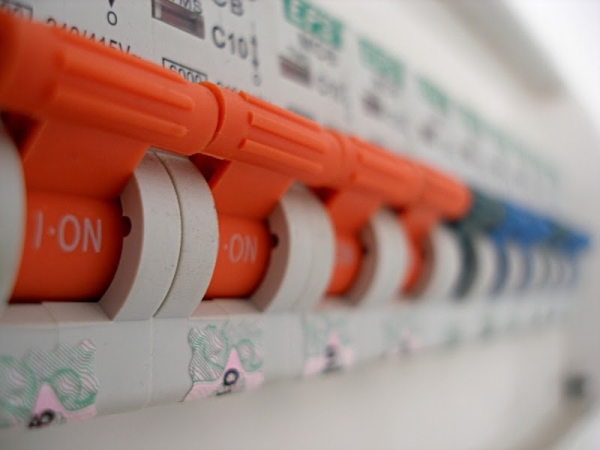
Circuit breakers are electromechanical devices used in the power system to connect or disconnect the power flow at the generator, substation, or load location. Only authorised persons with correct password can connect or disconnect the circuit breaker. Each Line will have separate passwords to operate, By entering the password the current state of the line is toggled. That is, the load will gets connected or disconnected. For verification, after entering the password you need to press the ‘=’ button on keypad (Which is just like an ‘ENTER’ key).
Block Diagram of the Password based Circuit Breaker
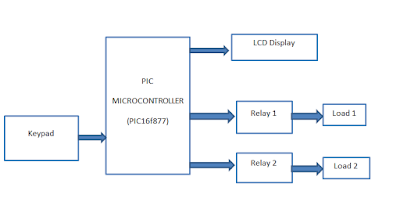
PIC16F877 is the heart of this project, which takes input from keypad as password and displays the current status on a 16×2 LCD Display. For the demonstration purpose, I am using only two loads, which is controlled by two relays.
“1234” and “9876” are the two passwords used here for activating and deactivating the Load 1 and Load 2 respectively. As I mentioned in the above paragraph, don’t forget to enter ‘=’ after feeding the password. Press ‘ON/C’ Button to clear the screen.
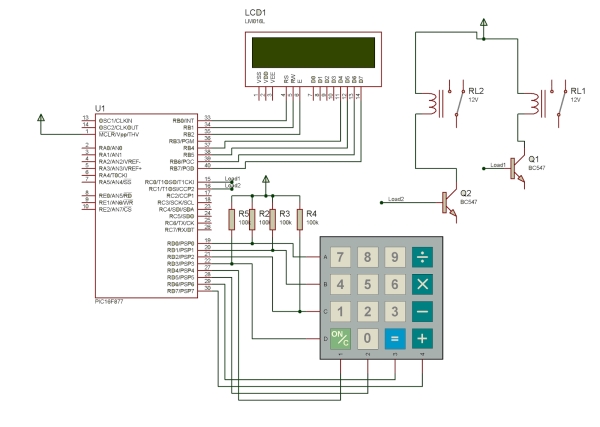
Circuit Diagram of Password Circuit Breaker
 Embedded C Code
- What is the main function of this circuit?
It connects or disconnects power flow at a load location only when an authorized person enters the correct password. - How do you verify the entered password?
You must press the '=' button on the keypad after typing the password to act like an 'ENTER' key. - Which microcontroller is used in this project?
The PIC16F877 is used as the heart of the project to process inputs and control outputs. - What are the specific passwords for Load 1 and Load 2?
The password "1234" activates Load 1 and "9876" activates Load 2. - How can you clear the screen during operation?
Press the 'ON/C' Button to clear the display screen. - Does each line have its own password?
Yes, each line has a separate password to operate the circuit breaker independently. - What happens after entering the correct password?
The current state of the line toggles, meaning the load gets connected or disconnected. - Can I download the code for this project?
Yes, the simulation, C-code, and project files can be downloaded from the source.
