Summary of 1.8MM HIGH 3D PRINTED STATUE OF LIBERTY FROM MICROLIGHT3D
Microlight3D used microlithography to 3D print a 1.8 mm tall, 0.6 mm wide replica of the Statue of Liberty directly onto a US one-cent coin using its Long-range Z process. The technique enables higher resolution than traditional red laser systems and extends photolithography build height from 0.3 mm to up to 10 mm on varied substrates (glass, silicon, metal). The system supports alignment to pre-existing patterns, printing on optical fiber tips, and fabrication of optical micro-parts, metamaterials, and medical devices.
Parts used in the Long-range Z 3D microprinting project:
- Long-range Z process 3D microprinter (Microlight3D system)
- Photolithography laser source (higher-resolution than traditional red laser systems)
- US one-cent coin (metallic substrate)
- Metallic and opaque substrates (general category: e.g., metal, silicon, glass)
- Optical fibers (for tip printing applications)
Microlithography is a very widely used technique for the production of micro-scale devices such as very tiny 3D printing in micrometer scale, semiconductor devices, and many other micro-scale products. French microlithography specialist Microlight3D has 3D printed the world’s smallest version of the Statue of Liberty for the inauguration of US President, Joe Biden.
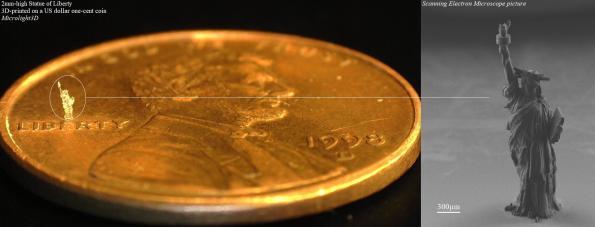
The 3D printed statue is 1.8mm tall and 0.6mm wide. It is printed with the company’s latest Long-range Z process and the statue was directly printed on a 1 cent coin which shows that the printing technology is compatible with a variety of printing substrates, notably metallic and opaque substrates. Using this process, higher resolution can be achieved than the traditional red laser systems. The Long-range Z process allows structures for optical micro-parts, meta-materials, and medical devices up to 10mm high using photolithography, up from 0.3mm previously, on a variety of substrates from glass and silicon to metal [1].
“Users will also be able to make alignments on a pre-existing pattern and print exactly where they want. We had great fun positioning the replica of the statue on the word ‘Liberty’ on a United States one-cent coin,” said Philippe Paliard, co-founder of Microlight3D.
He further added:
“Researchers and industrial developers are looking to work on metallic or silicon wafers. Our enhanced 3Dmicroprinting system, compatible with a wide range of materials and substrates, will allow them to micro-fabricate the structures they couldn’t before, to align the laser and print on the tip of optical fibers for micro-optics applications.”
Read more: 1.8MM HIGH 3D PRINTED STATUE OF LIBERTY FROM MICROLIGHT3D
- What was the size of the 3D printed Statue of Liberty?
The statue was 1.8 mm tall and 0.6 mm wide. - What printing process was used to make the miniature statue?
The Long-range Z process was used. - Was the statue printed directly on a coin?
Yes, it was printed directly on a United States one-cent coin. - Does the Long-range Z process work on metallic substrates?
Yes, it is compatible with metallic and opaque substrates including metal. - How does the resolution of the Long-range Z process compare to traditional red laser systems?
The Long-range Z process achieves higher resolution than traditional red laser systems. - What maximum structure height does the Long-range Z process allow?
It allows structures up to 10 mm high using photolithography, up from 0.3 mm previously. - Can users align and print on pre-existing patterns with this system?
Yes, users can make alignments on a pre-existing pattern and print exactly where they want. - What applications are mentioned for the enhanced 3D microprinting system?
Applications include optical micro-parts, meta-materials, medical devices, and printing on optical fiber tips for micro-optics.