
Summary of VISHAY’S NEW AUTOMOTIVE GRADE PROXIMITY SENSORS DELIVER HIGH RESOLUTION UP TO 20 ΜM FOR FORCE SENSING
Vishay Intertechnology introduced two new Automotive Grade proximity sensors, the VCNL3030X01 and VCNL3036X01, featuring 20 µm resolution for force sensing. These compact devices integrate a photodiode, amplifier, and ADC in a small surface-mount package. The VCNL3030X01 includes an onboard infrared emitter, while the VCNL3036X01 supports up to three external emitters. Both are AEC-Q101 qualified, support I²C communication, and offer programmable interrupts and selectable output resolutions to prevent false triggers in automotive and consumer applications.
Parts used in the Vishay Proximity Sensor Project:
- VCNL3030X01 sensor
- VCNL3036X01 sensor
- Photodiode
- Amplifier
- ADC circuitry
- Infrared emitter (IRED)
- I²C bus interface
- Microcontroller
The Optoelectronics group of Vishay Intertechnology, Inc. today introduced two new fully integrated Automotive Grade proximity sensors with high resolution up to 20 µm for force sensing applications. They each combine a photodiode, amplifier, and ADC circuitry in a 4 mm by 2.36 mm surface-mount package with a low 0.75 mm profile. The VCNL3030X01 features an on-board infrared emitter (IRED) while the VCNL3036X01 is designed to be used with up to three external IREDs, for which an onboard driver with internal logic is provided.
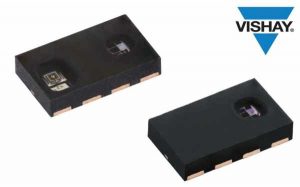
Ideally suited for use in automotive, consumer, smart home, industrial, office, and toy products, the AEC-Q101 qualified devices released today provide higher resolution compared to previous-generation sensors at a lower cost. When used for force sensing applications in steering wheel controls, laptop smart power buttons and multi-force trackpads, and touchpads for IoT devices and kitchen appliances, the VCNL3030X01 and VCNL3036X01 prevent false triggers and even allow users to wear gloves. Designed to work with external IREDs, the VCNL3036X01 provides increased flexibility for product design.
How It Works
The devices support the I²C bus communication interface, while their programmable interrupt function allows designers to specify high and low thresholds, which reduces the continuous communication with the microcontroller. Featuring selectable 12-bit and 16-bit outputs, the proximity sensors use intelligent cancellation to eliminate cross-talk, while a smart persistence scheme ensures accurate sensing and faster response time. The VCNL3030X01’s emitter wavelength peaks at 940 nm and has no visible “red-tail.”
Features
- Interrupt
- Programmable interrupt function for PS with upper and lower thresholds
- Adjustable persistence to prevent false triggers for PS
- Surface-mount 4.0mm x 2.36mm x 0.75mm (L x W x H) package
- AEC-Q101 qualified
- Infrared emitter (IRED), proximity sensor (PS), and signal conditioning IC Integrated modules
- Low power consumption I2C (SMBus compatible) interface
- Proximity function
- Immunity to red glow (940nm IRED)
- Programmable IRED sink current
- Intelligent cancellation to reduce cross talk phenomenon
- Smart persistence scheme to reduce PS response time
- Selectable for 12-/16-bit PS output data
- I2C bus (PS) Output type
- 2.5V to 3.6V Operation voltage
- 168h, MSL 3, according to J-STD-020 floor life
- What is the maximum resolution of these new sensors?
The sensors offer high resolution up to 20 µm. - How do the VCNL3030X01 and VCNL3036X01 differ regarding emitters?
The VCNL3030X01 features an on-board infrared emitter, while the VCNL3036X01 is designed for up to three external IREDs. - Can these sensors be used with gloves?
Yes, they allow users to wear gloves when used for force sensing applications. - Does the device support communication with a microcontroller?
Yes, the devices support the I²C bus communication interface. - How does the sensor prevent false triggers?
It uses a smart persistence scheme and adjustable persistence to prevent false triggers. - What are the available output data resolutions?
The sensors feature selectable 12-bit and 16-bit outputs. - Is the device qualified for automotive use?
Yes, the devices are AEC-Q101 qualified. - What is the operating voltage range?
The operating voltage ranges from 2.5V to 3.6V.