
Summary of Very Accurate LC Meter based on PIC16F628A
This Accurate LC Meter is an easy-to-build, highly precise instrument for measuring inductance (10 nH–100 mH) and capacitance (0.1 pF–900 nF). It uses an LM311 oscillator, PIC16F628A microcontroller, auto-ranging, and a reset function; the Special Edition kit includes premium components and a detachable LCD for professional-grade accuracy.
Parts used in the Accurate LC Meter:
- LM311 comparator IC (used as frequency generator)
- PIC16F628A microcontroller (programmed)
- 4.000 MHz crystal or resonator
- 16 character LCD display with yellow-green backlight
- LCD header connectors
- High precision capacitors (including Ccal 1000 pF)
- High precision inductor
- 1% Metal Film resistors
- Reset switch
- SW2 capacitance/inductance selector switch
- Machined IC sockets
- Gold plated header pins
- Double-sided PCB with red solder mask and pre-soldered tracks
- Various other standard passive components (resistors, capacitors, connectors)
About Accurate LC Meter
This is one of the most accurate and simplest LC inductance / capacitance Meters that one can find, yet one that you can easily build yourself. This LC Meter allows to measure incredibly small inductances starting from 10nH to 1000nH, 1uH to 1000uH, 1mH to 100mH and capacitance from 0.1pF up to 900nF. LC Meter’s circuit uses an auto ranging system so that way you do not need to spend time selecting ranges manually. Another neat function is reset switch that will reset the initial inductance / capacitance, making sure that the final readings of the LC Meter are as accurate as possible.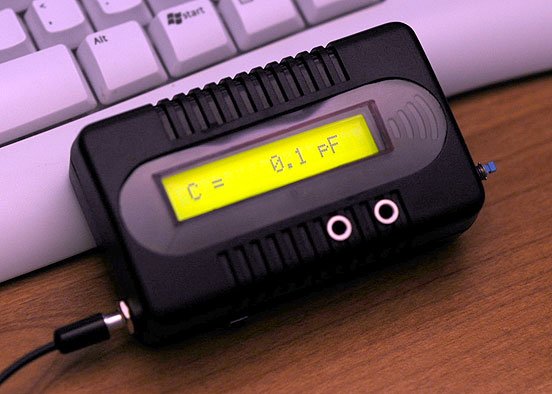
Special Edition Accurate LC Meter Kit
Special Edition LC Meter Kit includes top notch high precision components that are only found in premium quality kits. It includes high quality double-sided printed circuit board (PCB) with red solder mask and pre-soldered tracks for easier soldering, LCD display with yellow-green LED backlight, programmed PIC16F628A microcontroller chip, high precision capacitors and inductor, 1% Metal Film resistors, Machined IC Sockets, gold plated header pins, LCD header connectors and all the other components that are needed to build a premium quality kit. Thanks to the use of LCD connectors LCD display can be detached from the main PCB board at any time even after the kit has been assembled. Special Edition Accurate LC Meter is designed for professionals that require unprecedented measurement accuracy and offers great value at low cost.
How does LC Meter Work?
To be able to determine the value of an unknown inductor / capacitor we can use the frequency formula given below.
Note that there are three variables that we can work with; f, L and C (f represents a frequency, L inductance and C capacitance). If we know the values of the two variables we may calculate the value of the third variable.
Lets say we want to determine the value of an unknown inductor with X inductance. We plug X inductance into the formula and we also use value of a known capacitor. Using this data we can calculate the frequency. Once we know the frequency we can use the power of the algebra and rewrite the above formula to solve for L (inductance). This time we will use the calculated frequency and a value of a known capacitor to calculate the inductance.
Isn’t this amazing? We just calculated the value of unknown inductor, and we may use the same technique to solve for the unknown capacitance and even frequency.
Applying the Theory to LC Meter’s Hardware
Now let’s use the above theory and apply it to electronics. The LC Meter uses a popular LM311 IC that that functions as a frequency generator and this is exactly what we need. If we want to calculate the value of an unknown inductor we use a known Ccal 1000pF capacitor and the value of an unknown inductor. LM311 will generate a frequency that we can measure with a frequency meter. Once we have this information we can use the frequency formula to calculate the inductance.
The same thing can be done for calculating the value of a unknown capacitor. This time we don’t know the value a capacitor so instead we use the value of a known inductor to calculate the frequency. Once we have that information we apply the formula to determine the capacitance.
All this sounds great, however if we want to determine the value of a lot of inductors / capacitors then this may become a very time consuming process. Sure, we can write a computer program to do all these calculations, but what if we don’t have an access to a computer or a frequency meter?
That’s were PIC16F628A microcontroller comes handy. PIC16F628A is like a small computer that can execute HEX programs that are written using an assembly language. PIC16F628A is a very flexible microcontroller because it has PINs which can be configured as inputs and outputs. Besides that, PIC16F628A IC requires very minimal number of external components like 4.000MHz crystal / resonator and a few resistors. Before PIC16F628A microcontroller can be used it has to be programmed with a HEX code which has to be sent from the computer. All Accurate LC Meter kits already come with microcontroller that is already programmed and ready to be used. The use of high-quality components, precise soldering, and reliable circuit board assembly services can further improve the accuracy, durability, and overall performance of an LC Meter.
In the next step we use the frequency generated by LM311 IC and pass it on to PIC 16F628A’s PIN 17. We designate this PIN as an input, as well as all other PINs that are directly connected to switches. User can use these inputs to tell the microcontroller to execute specified set of instructions or perform calculations.
Once the microcontroller will calculate the unknown inductance or capacitance it will use PINs that are designated as outputs and pass the results onto the 16 character green backlighted LCD display.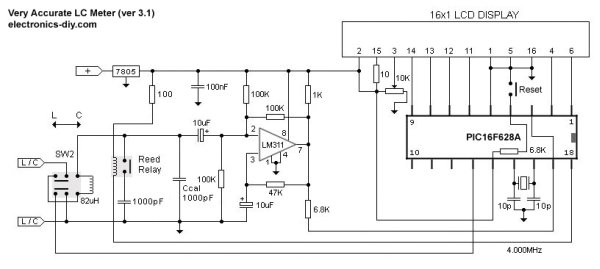
LC Meter’s Switches
Reset Switch – Resets capacitance / inductance readings
SW2 Switch – Capacitance / Inductance switch
Grounding PIC16F628A PIN12 displays the initial frequency of the LM311 oscillator which should be around 550KHz. This is usefull for testing LM311 oscillator.
For more detail: Very Accurate LC Meter based on PIC16F628A
- What measurement ranges does the LC Meter support?
It measures inductance from 10 nH to 100 mH and capacitance from 0.1 pF to 900 nF. - How does the LC Meter determine unknown inductance or capacitance?
It generates a frequency with the LM311 using a known C or L, measures frequency with the PIC16F628A, and calculates the unknown using the resonance formula. - Does the kit include a programmed microcontroller?
Yes, all Accurate LC Meter kits come with a PIC16F628A microcontroller that is already programmed and ready to use. - What is the purpose of the Ccal 1000 pF capacitor?
Ccal 1000 pF is used as the known capacitor when measuring unknown inductance. - Can the LCD be detached after assembly?
Yes, Special Edition kits use LCD connectors so the display can be detached from the main PCB even after assembly. - What does the reset switch do?
The reset switch resets the initial inductance or capacitance reading to ensure accurate final measurements. - What function does grounding PIC16F628A PIN12 provide?
Grounding PIN12 displays the initial LM311 oscillator frequency (around 550 kHz) for testing the oscillator. - Is the LC Meter auto-ranging?
Yes, the LC Meter uses an auto-ranging system so manual range selection is not required.