
Summary of Underground locator generator for Radiodetection using PIC16F628
This article describes a custom-built transmitter for the Radiodetection RD400 LLTS underground cable locator, designed to match the receiver's 512Hz and 8192Hz frequencies. The project uses a PIC16F628 microcontroller to generate modified sine waves from an 8-35VDC power source, aiding in locating breaks in underground cables like dog fence wires.
Parts used in the Underground Locator Transmitter:
- Radiodetection RD400 receiver
- PIC16F628 microcontroller
- Three-position rotary switch or center-off DPDT toggle switch
- LED indicator
- 20MHz crystal oscillator (XTAL)
- Transformer
- 120VAC power cable
- Test cables
- Ground rod
- Current clamp
Introduction
I obtained an early vintage Radiodetection® RD400 “LLTS” Precision Line Trace unit for a very low price through eBay. The RD400 is the receiver portion of a transmitter/receiver pair that comprise an underground cable locator system. Because the matching transmitter was not available (hence the low price,) I had to design one that matched the two audio frequencies detected by the receiver.
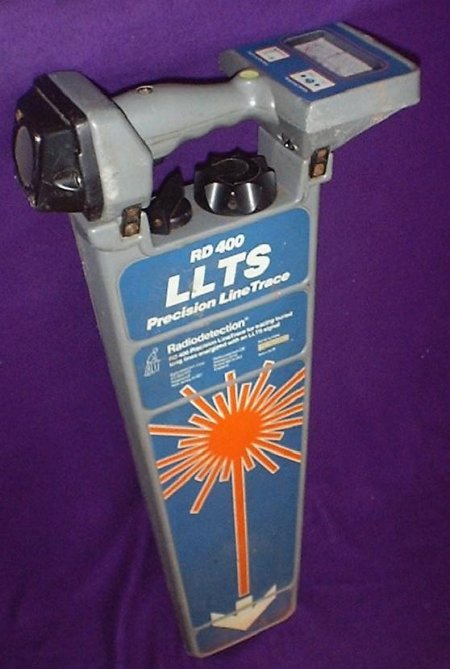
“LLTS” means Long Line Tracing System. Used with original transmitter, this unit was said to be capable of tracing signals in cables up to 45 miles. One of the most useful home-based applications of an underground locator is for locating breaks in the perimeter cable of underground dog fences!
Features
This transmitter is a simple design. The only control is a three-position rotary switch or center-off DPDT toggle switch. The transmitter is housed in a case that contains the 120VAC power cable, test cables, ground rod, and current clamp (not shown.)
Specifications
- Power: 8-35VDC such as from a wall adapter for 120VAC 60Hz
- Output: 512Hz or 8192Hz modified sine wave, 50-80VAC
Operation
Switch the unit on to either 512Hz or 8192Hz. The LED flashes slowly (1Hz rate) if 512Hz is selected; fast (16Hz rate) if 8192Hz is selected.
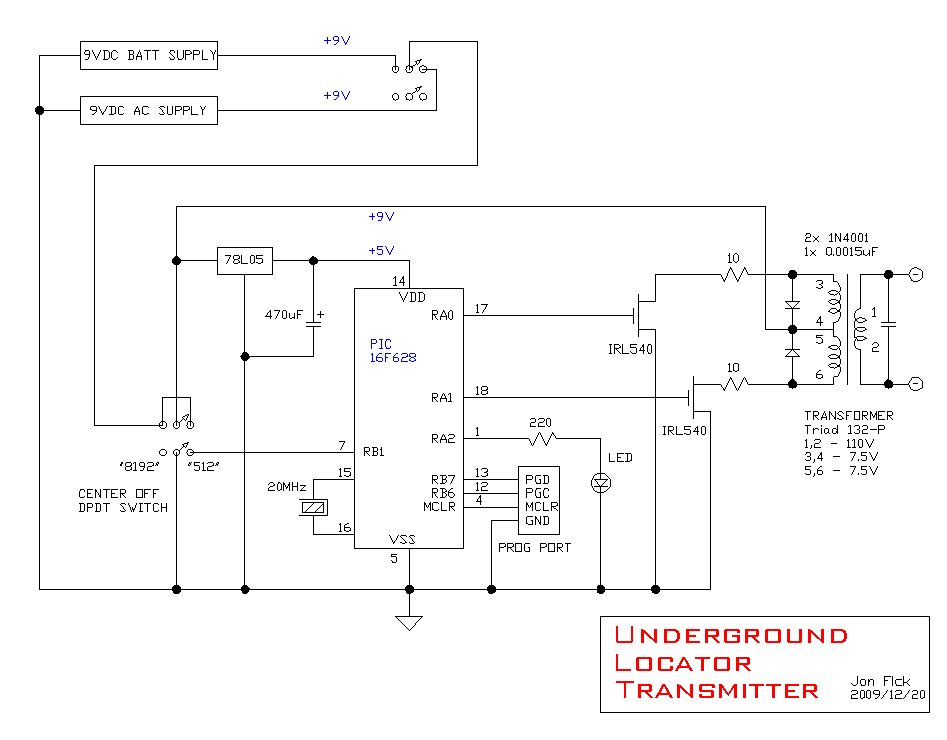
The receiver detects the electromagnetic field generated by the transmitters signal in the underground cable. Because magnetics are involved, and because magnetic fields are induced by current flow, and because current cannot flow without a complete circuit, it requires that whatever means of connection to the underground cable is used, signal current must be caused to flow in the cable being detected. Therefore, some thought may be necessary to get a useful signal into an underground cable.
/****************************************************************************
underground_locator_tx.c

This program is a transmitter for an underground locator that operates at 512Hz or 8192Hz.

Transformer coupled, modified sine wave

WORKING CODE

                    +5
                     |
                    14
                ----------
               |      RA0 |-17-- output 1
  MODE   ----7-| RB1      |
               |      RA1 |-18-- output 2
               |          |
               |  16F628  |-1--- LED
               |          |
               |      RB6 |-12-- PGD
               |      RB7 |-13-- PGC
 20MHz XTAL-15-|     MCLR |-4--- MCLR
       XTAL-16-|          |
                ----------
                     5
                     |
                    Gnd

***************************************************************************/
For more detail: Underground locator generator for Radiodetection using PIC16F628
- What is the primary purpose of this custom transmitter?
To match the two audio frequencies detected by the RD400 receiver for tracing underground cables. - How does the LED indicate the selected frequency?
The LED flashes slowly at 1Hz for 512Hz and fast at 16Hz for 8192Hz. - What power supply specifications are required for the unit?
The unit requires 8-35VDC, such as from a wall adapter for 120VAC 60Hz. - Does the system require a complete circuit to function?
Yes, current must flow in the cable being detected because magnetic fields are induced by current flow. - What type of wave output does the transmitter generate?
The transmitter generates a 512Hz or 8192Hz modified sine wave. - Can this device be used to locate breaks in dog fence cables?
Yes, one of the most useful home-based applications is locating breaks in the perimeter cable of underground dog fences. - What components are housed inside the transmitter case?
The case contains the 120VAC power cable, test cables, ground rod, and current clamp.
