
Summary of TINY DC-DC POWER MODULE – INPUT 8-28V DC – OUTPUT 5V DC 1A
This tiny power module integrates a 3A DC/DC converter (TPS54302) with MOSFETs, inductor, and passives in a 3-pin through-hole TO-220 style package, replacing LM7805-style linear regulators. It accepts 8–28V DC input and provides a 5V DC fixed output (1A) with higher efficiency and no heatsink required. TPS54302 features internal FETs, loop compensation, soft-start, Eco-mode for light loads, spread-spectrum for EMI reduction, and multiple overcurrent protections. Output can be adjusted using a precision resistor divider to the FB pin.
Parts used in the Tiny DC-DC Power Module:
- TPS54302 DC/DC converter chip (Texas Instruments)
- Integrated power MOSFETs (inside TPS54302 package)
- Inductor (on-module)
- Passive components (resistors, capacitors on-module)
- 3-pin through-hole TO-220 style package
- Resistor divider for output voltage setting (recommended 1% tolerance)
This tiny power module is an easy-to-use integrated power solution that combines a 3A DC/DC converter chip with inbuilt power MOSFETs, an inductor, and passives into a 3-pin, through-hole package. The standard TO-220 pin-out allows a much-improved replacement of linear regulators packaged in this industry-standard footprint. The circuit provides much higher efficiency and output current without the need for a heatsink. This is an easy replacement of the LM7805 linear regulator with higher input voltage and output current than LM7805. Operating supply 8-28V DC, output 5V DC at 1A. The project is built using the TPS54302 chip from Texas instruments.
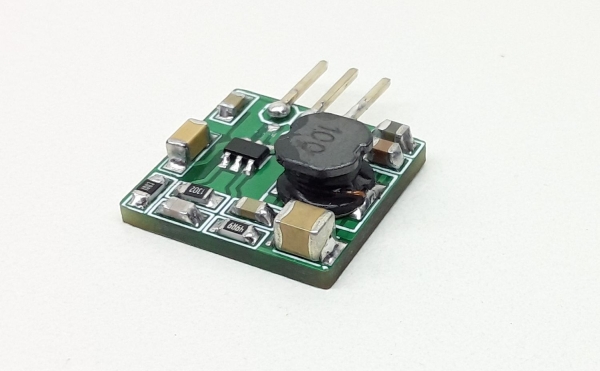
The TPS54302 is a 4.5-V to 28-V input voltage range, 3-A synchronous buck converter. The device includes two integrated switching FETs, internal loop compensation and 5-ms internal soft start to reduce component count. By integrating the MOSFETs and employing the SOT- 23 package, the TPS54302 achieves the high-power density and offers a small footprint on the PCB. Advanced Eco-mode implementation maximizes the light load efficiency and reduces power loss. In the TPS54302, the frequency spread-spectrum operation is introduced for EMI reduction. Cycle-by-cycle current limit in both high-side MOSFET protects the converter in an overload condition and is enhanced by a low-side MOSFET freewheeling current limit which prevents current runaway. Hiccup mode protection is triggered if the overcurrent condition has persisted for longer than the present time.
OUTPUT
The circuit provides a fixed 5V DC and this can be changed. The output voltage is set with a resistor divider from the output node to the FB pin. It is recommended to use divider resistors with 1% tolerance or better. Start with 100 kΩ for the upper resistor divider and use Equation 3 to calculate the output voltage. To improve efficiency at light loads consider using large value resistors but keep in mind that if the values are too high the regulator is more susceptible to noise and voltage errors from the FB input current are noticeable.
Read more: TINY DC-DC POWER MODULE – INPUT 8-28V DC – OUTPUT 5V DC 1A
- What input voltage range does the module accept?
The module accepts 8–28V DC input as stated in the article. - What is the fixed output voltage and current of the module?
The circuit provides a fixed 5V DC output at 1A as described. - Can the output voltage be changed?
Yes, the output voltage can be changed using a resistor divider from the output node to the FB pin. - What resistor tolerance is recommended for the output divider?
Resistor divider resistors with 1% tolerance or better are recommended. - Why is this module a better replacement than an LM7805?
It offers much higher efficiency and output current without the need for a heatsink, and supports higher input voltage and output current than the LM7805. - Which chip is used in this project?
The project is built using the TPS54302 chip from Texas Instruments. - What protections does the TPS54302 provide?
It provides cycle-by-cycle current limit on the high-side MOSFET, low-side freewheeling current limit, and hiccup mode protection for sustained overcurrent, as described. - Does the device include features to reduce EMI and improve light-load efficiency?
Yes, it uses frequency spread-spectrum operation for EMI reduction and an advanced Eco-mode to maximize light-load efficiency. - What internal features reduce component count on the module?
The TPS54302 integrates two switching FETs, internal loop compensation, and a 5-ms internal soft start, reducing external component count.