
Summary of THE NEW TIEPIE ENGINEERING HANDYSCOPE HS6 IS 4 CHANNEL 1 GSA/S LOW NOISE USB 3.0 OSCILLOSCOPE
TiePie engineering’s Handyscope HS6 is a USB 3.0, four‑channel oscilloscope available from 200 MSa/s up to 1 GSa/s. It offers flexible 8–16 bit resolution, 0.25% accuracy, low noise (240 µVrms), CMI multi-unit synchronization for scalable synchronized channels, and SureConnect real‑time probe connection testing to ensure reliable physical and electrical contact during measurements.
Parts used in the Handyscope HS6:
- Handyscope HS6 USB 3.0 oscilloscope unit
- USB 3.0 interface/cable
- Analog input channels (4 channels)
- CMI interface for combining units
- SureConnect connection test circuitry
- ADC with flexible resolution (8 to 16 bit)
- High sample-rate front-end (200 MSa/s to 1 GSa/s)
- Low-noise signal conditioning components (supporting 240 µVrms)
The 4 channel 1 GSa/s low noise USB 3.0 oscilloscope packed with technology
TiePie engineering has introduced the Handyscope HS6, a USB 3.0 oscilloscope packed with technology. This new four channel high resolution low noise oscilloscope is available in models with 200 MSa/s up to 1 GSa/s sampling rate, with several features that are unique to TiePie engineering.
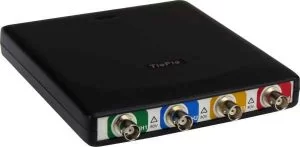
The Handyscope HS6 has a flexible resolution that can be set from 8 bit to 16 bit, allowing to perform high resolution measurements. With its high accuracy (0.25 %) and low noise (240 µVrms), measured signals are presented with high fidelitty.
The Handyscope HS6 features TiePie engineering’s unique CMI interface. It allows connecting more Handyscope HS6’s together to create an instrument with multiple measuring channels with the same sample frequency (0 ppm deviation!). Why: The user can easily expand the number of channels without changing software, difficult software settings or buying expensive hardware. CMI = Combining multiple instruments, meaning that the CMI interface offers the possibility of an 8, 16, 32 or even 128 channel oscilloscope or data recorder where all channels are measured fully synchronized with sampling rates up to 1 GSa/s and resolutions up to 16 bit.
Also unique to TiePie engineering is the SureConnect connection test option. While measuring, the revolutionary SureConnect technology checks in real-time whether a test probe is in physical and electrical contact with the test subject.
Why: Assuring a good connection of a probe with a test subject may not always be easy. The subject under measurement may be dirty, oxidized or an (invisible) protective layer may be present. Also, the test subject may be hidden, making visible contact confirmation impossible.
Capacitive coupling between test probe and test subject can result in measuring a distorted version of the actual signal, wrongly suggesting a connection. SureConnect however immediately shows you whether a good connection is present.
Read more: THE NEW TIEPIE ENGINEERING HANDYSCOPE HS6 IS 4 CHANNEL 1 GSA/S LOW NOISE USB 3.0 OSCILLOSCOPE
- What sampling rates are available for the Handyscope HS6?
The Handyscope HS6 is available in models from 200 MSa/s up to 1 GSa/s. - How many channels does the Handyscope HS6 have?
The Handyscope HS6 has four analog input channels. - What resolution can be set on the Handyscope HS6?
The resolution is flexible and can be set from 8 bit to 16 bit. - What is the noise performance of the Handyscope HS6?
The Handyscope HS6 has low noise specified at 240 µVrms. - What accuracy does the Handyscope HS6 offer?
The Handyscope HS6 offers high accuracy of 0.25%. - Can multiple Handyscope HS6 units be combined for more channels?
Yes, the CMI interface allows connecting multiple Handyscope HS6 units to create synchronized multi‑channel instruments. - Does combining units change the sample frequency alignment?
No, CMI provides the same sample frequency with 0 ppm deviation across combined units. - What does the SureConnect feature do?
SureConnect checks in real time whether a test probe is in physical and electrical contact with the test subject. - Why is SureConnect useful?
SureConnect ensures a good probe connection even when the subject is dirty, oxidized, has a protective layer, or when visible confirmation is impossible.