Summary of THE NEW PANASONIC INDUSTRY PAN1781 BLUETOOTH 5 LOW ENERGY MODULE
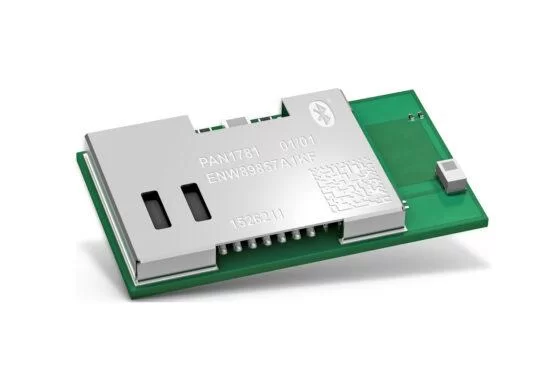
The new PAN1781 from Panasonic Industry is a compact Bluetooth 5 Low Energy module based on the Nordic nRF52820, positioned as a lower-cost, lower-memory counterpart to the PAN1780. It supports LE 2M PHY, LE coded PHY (500/125 kb/s), CSA#2, advertising extensions, up to 8 dBm output power, and software stacks (BLE 5.1, ZigBee, Thread), making it suitable for mid- and high-volume applications needing essential Bluetooth connectivity and optional long-range performance.
Parts used in the PAN1781 Project:
- PAN1781 Bluetooth 5 Low Energy module
- Nordic nRF52820 single-chip controller (integrated in module)
Lightweight evolution – and a new member for the Nordic Semiconductor-based Bluetooth Module family: The new PAN1781 from Panasonic Industry suits a wide range of mid and high-volume application designs.
“With the PAN1781 being the little brother of our undoubtedly successful PAN1780, we are now rounding out our module range on the lower ends”, opens Jan Scheller from Panasonic Industry.
The PAN1781 is a Bluetooth® 5 Low Energy module based on the Nordic nRF52820 single-chip controller and is, in a way, the lightweight version of the PAN1780. Bluetooth® 5 features additionally a higher symbol rate of 2 Mbps using the high-speed LE 2M PHY or a significantly longer range using the LE coded PHY at 500 kb/s or 125 kb/s. The new channel selection algorithm (CSA#2) improves the performance in high interference environments. Furthermore, the new Low Energy advertising extensions allow for much larger amounts of data to be broadcasted in connectionless scenarios.
“The module is an attractive solution because of its truly flexible usability enabled by the attractive software stacks available via the Nordic portal, for instance Bluetooth® Low Energy 5.1, ZigBee and Thread”, continues Scheller. “Thus, the PAN1781 is an allrounder that perfectly qualifies for many different applications and markets. It comes with the same specs as the PAN1780, but due to its reduced memory it is a highly economical choice for each context that requires an essential Bluetooth® interface.”
An output power of up to 8 dBm and the high sensitivity of the nRF52820 in combination with the LE coded PHY render the module an ideal choice for applications, where a long-range is required.
Read more: THE NEW PANASONIC INDUSTRY PAN1781 BLUETOOTH 5 LOW ENERGY MODULE
- What controller is the PAN1781 based on?
The PAN1781 is based on the Nordic nRF52820 single-chip controller. - Does the PAN1781 support Bluetooth 5 features like 2 Mbps and long range?
Yes, it supports LE 2M PHY for 2 Mbps and LE coded PHY for longer range at 500 kb/s or 125 kb/s. - What is the maximum output power of the PAN1781?
The module offers an output power of up to 8 dBm. - Can the PAN1781 be used with ZigBee and Thread stacks?
Yes, the module supports software stacks available via the Nordic portal, including ZigBee and Thread. - How does the PAN1781 differ from the PAN1780?
The PAN1781 has reduced memory compared to the PAN1780, making it a more economical choice while keeping the same specs otherwise. - Is the PAN1781 suitable for high-interference environments?
Yes, the new channel selection algorithm CSA#2 improves performance in high interference environments. - Are Bluetooth Low Energy advertising extensions supported by the PAN1781?
Yes, the module supports Low Energy advertising extensions to broadcast larger amounts of data in connectionless scenarios. - What kinds of applications is the PAN1781 aimed at?
It is aimed at a wide range of mid- and high-volume application designs that require an essential Bluetooth interface and optionally long-range connectivity.