Summary of LIFEPO4 CHARGER BOARD BASED ON CN3058E
LiFePO4 batteries (LFP) use lithium iron phosphate cathodes and graphitic carbon anodes, offering lower voltage and conductivity but advantages like low toxicity, cost, high stability, long calendar life (~3.2V nominal), and improved safety vs LiCoO2. Stefan Wagner’s LFP power board charges LiFePO4 cells and supplies uninterrupted 3.3V projects, switching between battery and external power using a CN3058E charger IC, an HY2112 protection IC, a pass transistor, and a Schottky diode for load sharing.
Parts used in the LFP Power Board:
- LiFePO4 battery (LFP cell, nominal 3.2V)
- CN3058E battery charger IC
- HY2112 battery-pack protection IC
- Pass transistor (for load sharing)
- Schottky diode (for load sharing)
- Printed circuit board (PCB) designed by Stefan Wagner
- External power supply input
LiFePO4 Batteries: An Overview
Compact electronic devices rely on concise li-ion battery packs. Lithium iron phosphate battery (LiFEPO4) or LFP battery is a type of lithium-ion battery that uses lithium iron phosphate as a cathode and a graphitic carbon electrode as the anode.
LFP batteries have a lower operating voltage and also present lower electrical conductivity. But they have some significant advantages over lithium-ion batteries like low toxicity, low cost, high stability, high performance, etc. Due to these advantages, LFP batteries find several roles in automotive industries, Uninterruptible power supplies, and other low power applications.
LFP batteries have a very constant output voltage that stays fixed around 3.2V (nominal voltage of the battery) during discharge cycles. They also have a longer calendar life. Calendar life or shelf life is the time for which a battery can store charge being inactive or with minimal use. Other than that, LFP batteries are thermally and electrically stable, which makes them safer than traditional LiCoO2 batteries.
LFP Power Board
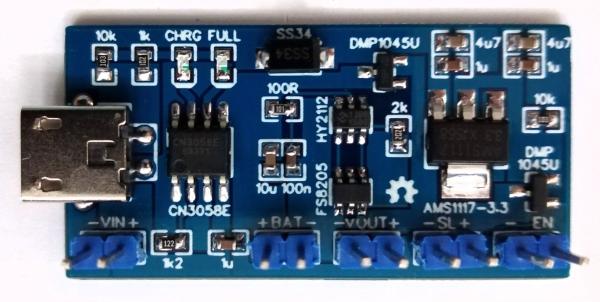
Stefan Wagner from Germany designed a PCB for LFP batteries power board. The board can charge LiFePO4 batteries and also power the load uninterruptedly. The board is developed for 3.3V projects and can be operated by both battery and external power supply.
The board uses CN3058E battery charger IC and HY2112, a battery-pack protection IC. There is a load-sharing system that interrupts the connection between the battery and the load when an external power supply is connected. The load-sharing system is implemented by a pass transistor and a Schottky diode. When an external voltage is detected at the gate of the pass transistor, the voltage from the battery is interrupted.
Read more: LIFEPO4 CHARGER BOARD BASED ON CN3058E
- What is the nominal voltage of a LiFePO4 battery?
The article states the nominal voltage stays around 3.2V during discharge cycles. - Can the power board charge LiFePO4 batteries?
Yes, the board can charge LiFePO4 batteries using the CN3058E charger IC. - Does the board provide uninterrupted power to the load?
Yes, the board powers the load uninterruptedly and switches between battery and external power. - How is load sharing implemented on the board?
Load sharing is implemented by a pass transistor and a Schottky diode that interrupt battery connection when external power is present. - Which IC is used for battery-pack protection?
The HY2112 battery-pack protection IC is used for protection. - Is the board intended for a specific operating voltage for projects?
Yes, the board is developed for 3.3V projects. - What happens when external voltage is detected at the pass transistor gate?
When external voltage is detected at the gate, the voltage from the battery is interrupted. - Why are LFP batteries considered safer than LiCoO2 batteries?
The article says LFP batteries are thermally and electrically stable, making them safer than LiCoO2 batteries.