


Summary of Speed control of DC motor by PWM in Proteus simulation
Summary: This article describes a Proteus simulation demonstrating DC motor speed control using PWM generated by an 8051 microcontroller. Two push buttons adjust PWM duty cycle to increase or decrease motor speed; the PWM waveform can be observed on an oscilloscope in the simulation. The author used single-transistor switching instead of a full H-bridge and provides download links for the Proteus files, C source, and debug file.Parts used in the Speed control of DC motor by PWM in Proteus simulation:
- Proteus simulation software (Proteus 8 demo mentioned)
- 8051 microcontroller
- DC motor (simulated)
- Single switching transistor (for motor drive)
- Two push buttons (for duty cycle increase/decrease)
- Oscilloscope (for viewing PWM waveform)
- Proteus project files, C program, and debug file (downloads provided)

As we have discussed earlier that proteus is a really good simulation software for beginners and 8051 is the most basic among all microcontroller so this can be a very good project of motor control if you are doing it for first time.
Originally this simulation was given in demo file of Proteus 8, but full H- bridge control was used there but i have used only one transistor switching to transfer PWM to motor.
Here two push buttons are used to control the duty cycle of PWM signal generated by 8051. You can see the PWM signal changing on oscilloscope when we press the buttons. (You can use these buttons to increase or decrease pulse width.)
Here is the link to download simulation files, C program and debug file for PWM generation by 8051 microcontroller.
If you have any query or suggestions you can always comment below. 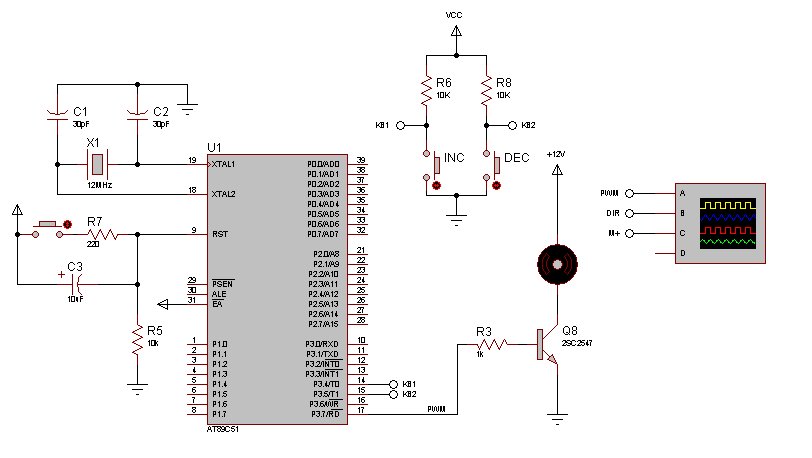
Incoming search terms:
- SpeedcontrolofDCmotorbyPWMinProteussimulation-GeniusDevils
- dc motor spedd control in proteus using ic555
- simulation for dc motor control speed through Bluetooth
- how to give pwm in 8051 proteus simulation
- dc motor simulation using micro controller
- dc motor proteus
- PWM in proteus example
- pwm fan speed control in proteus
- PWM DC Motor Speed Control
- pwm fan using micro controller
- pwm control motor by arduino in proteus
- pwm based motor speed control using push boton
- proteus schematis diagram for speed control of dc motor using audio via bluetooth
- proteus isis bldc motor
- proteus bldc
- proteus arduino dc motor
- program to generate pwm using atmega168
- program for dc motor control using pwn usind arduino programming usung arduino software with proteus output simulation
- pwm proteus
- pwm speed control on simulation project
- vibrating motors proteus
- speed sensor in proteous
- speed control of dc motor using 8051 project
- speed control of dc motor program using protius
- speed control motor dc proteus arduino
- simulation of speed measurement using pulses in Proteus
- simulation of speed control of dc motor using remote
- simulation of dc motor controll with button pic
- simulate motor proteus
- simple circuit simulation to control the speed of dc motor in proteus
Source : Speed control of DC motor by PWM in Proteus simulation
Quick Solutions to Questions related to Speed control of DC motor by PWM in Proteus simulation:
- How is PWM generated in this project?
PWM is generated by the 8051 microcontroller as described in the article. - Can the PWM duty cycle be changed during simulation?
Yes, two push buttons are used to increase or decrease the PWM duty cycle during simulation. - Does the simulation use a full H-bridge for motor control?
No, the article states a single transistor switching is used instead of a full H-bridge. - What software is used for the simulation?
Proteus (Proteus 8 demo file is mentioned) is used for the simulation. - Is there a way to observe the PWM signal in the simulation?
Yes, the PWM signal can be observed on the oscilloscope within the Proteus simulation. - Are source code and project files available?
Yes, the article provides a link to download simulation files, the C program, and the debug file. - Is this project suitable for beginners?
Yes, the article suggests Proteus is good for beginners and 8051 is a basic microcontroller, making this a suitable introductory project. - Can this simulation be adapted to use other microcontrollers like Arduino?
The article lists related search terms including Arduino, but it only describes the 8051-based Proteus simulation itself.
Related projects
Real-Time CAN-Based Vehicle Monitoring System with PIC MCU
INTRODUCTION The Controller Area Network (CAN) is a robust vehicle communication bus standard that was primarily developed for automobile applications but has...
Motors & RoboticsEasy Way to Learn Robotics Using Microcontrollers: A Beginner’s Guide
The title, "Easy Way to Learn Robotics Using Microcontrollers," promises an accessible entry point for those curious about the exciting world of...
Motors & Robotics · PIC16F877AEfficient Sun-Following Robot: A Solar Tracker with Microcontroller Control
Abstract The impending global challenge of dwindling non-renewable fuel resources underscores the urgency of transitioning towards renewable energy alternatives like solar power....
Motors & RoboticsInnovative Robotics: A Comprehensive Project Exploration
A DC motor functions as an electromechanical device, translating electrical signals into mechanical movements. The rotation of the motor correlates directly with...
Motors & RoboticsAdvanced Techniques for Fault Detection, Indication, and Protection in Induction Motors
1. INTRODUCTION The impact of microcontroller usage on our daily lives is remarkable. This versatile device is now prevalent in various control...
Motors & RoboticsExploring Versatility: GSM-Based Robotic Vehicle Technology
Introduction To Robotics The term 'Robot' remains elusive, defying a precise definition due to its evolving usage. Initially, it referred to humanoid...

Ibrar Ayyub
I am an experienced technical writer holding a Master's degree in computer science from BZU Multan, Pakistan University. With a background spanning various industries, particularly in home automation and engineering, I have honed my skills in crafting clear and concise content. Proficient in leveraging infographics and diagrams, I strive to simplify complex concepts for readers. My strength lies in thorough...