Summary of Smart Battery Charger (no soldering!)
This tutorial builds a low-power, always-on NiCd/NiMH battery charger using an Espruino microcontroller to individually charge, discharge, and measure batteries, providing occasional full discharges and capacity estimates. It charges batteries slowly via GPIO pins (no fast charging), supports single or odd-numbered battery counts, and is simple to build without soldering.
Parts used in the Smart Battery Charger:
- Espruino microcontroller (e.g., Espruino board)
- Battery holders for AA or AAA cells
- Wires or jumper leads
- Resistors (as required for current limiting per tutorial)
- Optional indicator LEDs
- USB power source or 5V supply
- Optional connectors or breadboard for assembling without soldering
Many AA or AAA battery chargers charge batteries in pairs, but plenty of devices use 1 or 3 batteries, meaning that some of your batteries get overcharged and some get undercharged. NiCd and NiMH batteries also benefit from an occasional full discharge, which most normal battery chargers won’t do.
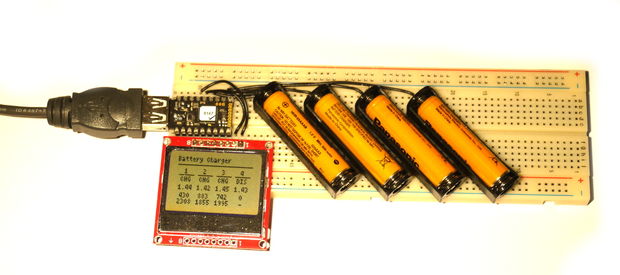
If you’re anything like me you’ll end up with a lot of rechargeable batteries, none of which end up being charged properly, and some of which turn out to be completely unusable. It’d be perfect if you had a low-power battery charger that you could leave on all the time, that would charge your batteries individually, automatically discharge them, and give you an idea of their real capacity. That’s what you’ll make in this tutorial!
Note: To make this nice and easy, the charger uses Espruino’s GPIO pins to directly charge and discharge the batteries. This means it can’t charge batteries very quickly (it can take days to charge and discharge them!). NiMH batteries benefit from an occasional fast charge/discharge, which this charger can’t provide without some extra components – so it’s not perfect, but it is easy to build and will make sure your batteries are always topped up.
For more detail: Smart Battery Charger (no soldering!)
- Can this charger charge single or three batteries properly?
Yes. The charger charges batteries individually using Espruino GPIO, so odd numbers like 1 or 3 are supported. - Does this charger perform fast charging?
No. It charges and discharges slowly via GPIO and cannot provide fast charge without extra components. - Will this charger perform full discharges?
Yes. It can automatically discharge batteries to provide occasional full discharges and estimate capacity. - Is soldering required to build this charger?
No. The tutorial describes a no-soldering build using connectors, battery holders, and a breadboard or jumper leads. - Can NiMH batteries benefit from this charger?
Partly. NiMH batteries benefit from occasional full discharge, which this charger provides, but it cannot do fast charge/discharge without extra components. - How long does charging and discharging take?
Charging and discharging can take days because the charger uses low-power GPIO-based charging. - Does the charger measure battery capacity?
Yes. The charger gives an idea of real capacity by charging and discharging batteries and measuring their performance.