Summary of Serial 4-digit seven segment LED display
This article describes a compact 4-digit seven-segment LED display module driven by an SPI interface, requiring only three MCU pins. Based on the MAX7219 driver chip, it solves the high I/O pin count issue of standard multiplexing. The module features two colon segments for time display and allows brightness adjustment via internal PWM.
Parts used in the Serial 4-digit Seven Segment LED Display:
- MAX7219 LED display driver chip
- LITE-ON LTC-4727JS seven segment display module
- External resistor for segment current setting
- MCU with SPI interface
This project is a 7 segment LED display module that can be driven using SPI protocol, so it needs only 3 pins of your mcu to drive 4 x LED displays. It’s based on MAX7219 LED display driver.
Description
Seven segment LED displays are very popular for displaying numeric information because they are very attractive and readable from a far distance and wider viewing angle.
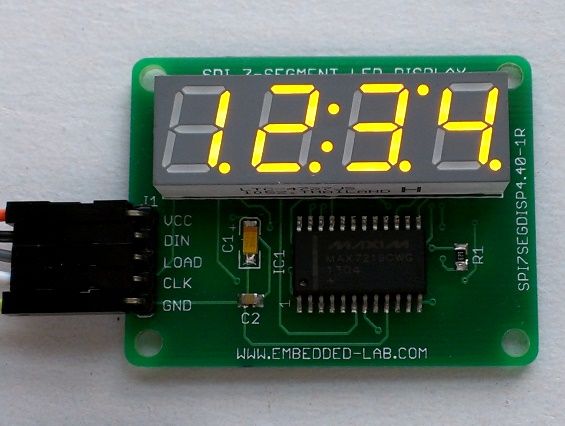
The downside is they are resource-hungry. For example, it requires 12 I/O pins of a MCU to drive a 4-digit seven segment display using a standard time-division multiplexing technique.
Here I present a serial seven segment LED display module that can be used with any MCU using a 3-wire SPI interface. This particular display has four digits (0.40 size) and two colon segments (to support time display) display.
Schematic
The main controller of this display module is MAXIMs MAX7219 driver chip. Included on-chip are a BCD decoder, multiplex scan circuitry, segment and digit drivers, an 8×8 static RAM to store the digit values, and a 3-pin SPI interface to receive the display data from the host MCU.
The segment current for all LEDs is set through only one external resistor. However, the device also provides a digital control of the display brightness (16 steps from minimum to maximum) through an internal pulse-width modulator.
The seven segment module used in this project is LITE-ON, Inc.s LTC-4727JS module, which has LED segment arrangement and pin configuration as shown in figure below.
For more detail: Serial 4-digit seven segment LED display
- How many MCU pins are required to drive this display?
Only 3 pins using a 3-wire SPI interface. - What is the main controller chip used in this project?
The project uses Maxim's MAX7219 driver chip. - Can the display brightness be adjusted digitally?
Yes, it provides digital control with 16 steps from minimum to maximum. - Does the display support showing time?
Yes, it includes two colon segments to support time display. - How does this module compare to standard time-division multiplexing in terms of pin usage?
Standard techniques require 12 I/O pins, while this module needs only 3. - What type of interface does the MAX7219 use to receive data?
It uses a 3-pin SPI interface. - Is there static RAM included on the MAX7219 chip?
Yes, it includes an 8×8 static RAM to store digit values.